 HEADSHOTLAB
The Second Face: How LinkedIn Headshot AI Quietly Became the New Office Attire
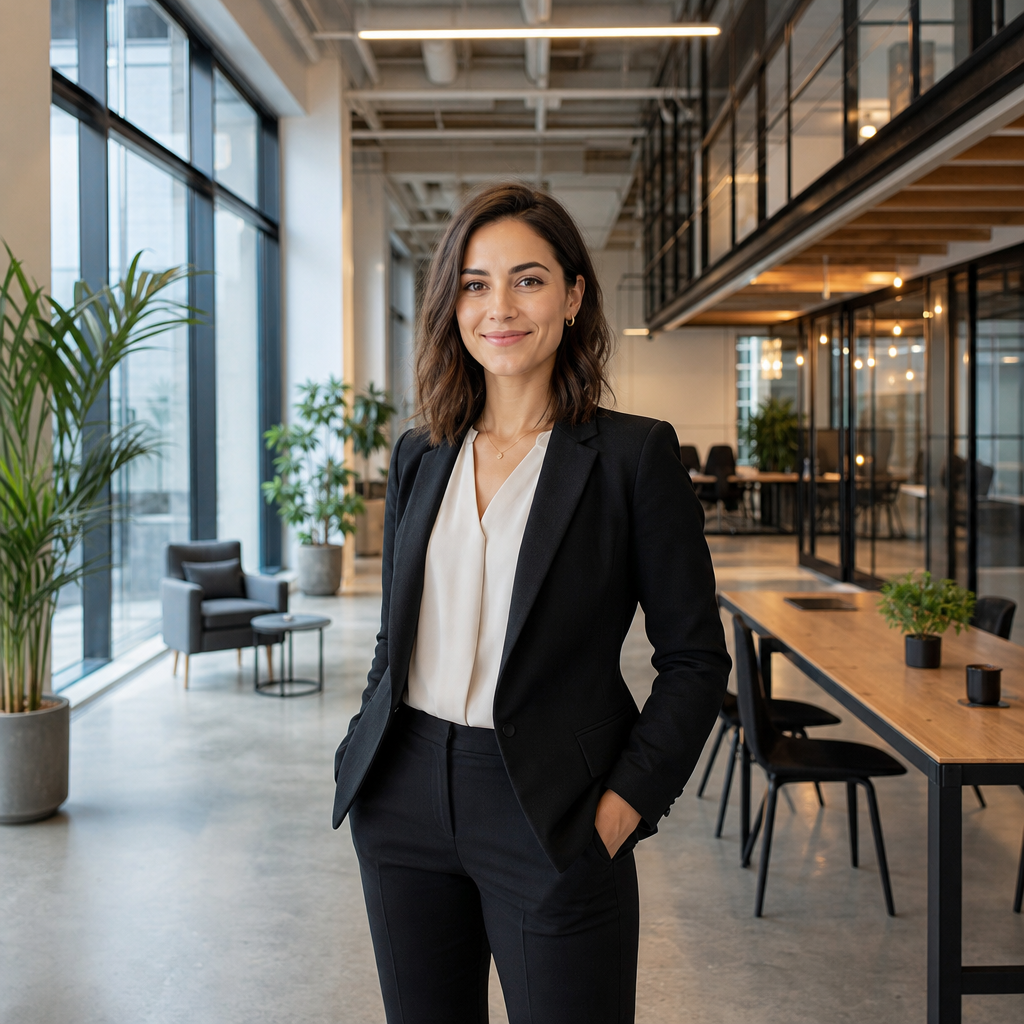
There is a particular kind of quiet that falls over a person scrolling through forty versions of their own face. Not vanity, exactly — something closer to reckoning. A woman in Minneapolis, between client calls, flips through a grid of portraits of herself in a charcoal blazer she has never owned, standing in front of a bookshelf that does not exist, under a window light that was never in the room. She looks, in every frame, like someone who has her life handled. She picks one. She uploads it. Within the hour, three recruiters have viewed her profile. This is not science fiction. This is a Tuesday.
The rise of LinkedIn headshot AI is one of those shifts that happened without a headline moment — no keynote, no breathless unveiling, just a slow accumulation of millions of ordinary people deciding that the bathroom-mirror selfie or the cropped wedding photo was no longer going to be the face they presented to the professional world. What used to require a studio, a stylist, a free Saturday, and somewhere between two and five hundred dollars now takes the time it takes to make a coffee. The transformation is not merely technical. It is a change in how we understand the professional self — how much of it is performance, how much of it can be outsourced to software, and what gets lost or gained when the camera is no longer a person with opinions about your chin.
Photography has always been a negotiation between subject and lens. What's new is that the negotiation now happens inside a neural network trained on hundreds of thousands of studio portraits, corporate headshots, and editorial lighting setups — a machine that has, in effect, absorbed the collective visual grammar of "looking competent" and can apply it to anyone's face on demand. Services like Headshot Lab have turned this into something closer to a ritual than a transaction: upload a handful of selfies, choose a wardrobe and a backdrop, and receive dozens of polished options, often within the hour, at a fraction of what a photographer in a rented studio would charge. The company's money-back guarantee and retouch credits suggest an operation that understands its real product isn't the image — it's the confidence of the person clicking "download."
The Studio That Lives in Your Phone
For most of the twentieth century, a professional portrait meant an appointment. You drove somewhere, usually a strip-mall studio with a gray backdrop on a roller and a photographer who'd shot ten thousand almost-identical faces that year. The lighting was serviceable, the mood vaguely funereal, and the final print arrived in a cardboard folder you'd forget in a drawer. Later came the LinkedIn era proper — the mid-2010s rush of young professionals cornering a friend with a decent camera, standing against a blank office wall, squinting into unflattering fluorescent light. Anyone who graduated into the job market between, say, 2012 and 2019 has a version of this photo somewhere, usually cropped badly from a group shot at a conference.
What's changed is not just convenience but expectation. A LinkedIn profile today functions less like a résumé addendum and more like a storefront window — the first and sometimes only impression a hiring manager, client, or investor forms before any words are exchanged. Microsoft's own research into LinkedIn's algorithm and engagement patterns has repeatedly pointed to photo quality as one of the strongest predictors of profile views and connection acceptance. That statistic alone has created an entire quiet industry. People who would never describe themselves as vain have started treating their profile photo the way editors treat a magazine cover — something considered, edited, occasionally re-shot.
The AI headshot, in this context, isn't a gimmick so much as an answer to a structural problem: professional polish has always been unevenly distributed, tied to who could afford a photographer, who had access to good lighting, who even knew what "professional" was supposed to look like in a given industry. A generative tool that can turn a dim selfie into something resembling an editorial portrait flattens that inequality somewhat, for better or worse. It's worth sitting with the "or worse." There is something faintly uncanny about a face that has been smoothed, relit, and reclothed by an algorithm — a sense that we are looking at a very good impression of a person rather than the person. But the uncanny valley has narrowed considerably since the earliest AI portrait generators of 2022 and 2023, which tended to produce extra fingers, asymmetrical earrings, and the dead-eyed sheen of a wax museum. The current generation of tools, including those powering Headshot Lab's processing pipeline, lean on diffusion models fine-tuned specifically on professional portraiture, which means the results increasingly pass the test that matters most: a colleague glancing at the photo and not clocking anything unusual at all.
The Etiquette of the Artificial Portrait
There is an entire unwritten etiquette emerging around these images, not unlike the quiet rules that govern email sign-offs or whether you can wear sneakers to a client dinner. Is it acceptable to use a headshot where you're wearing a blazer you don't own? Where the background is a soft-focus library that bears no resemblance to your actual office, which is, in reality, a converted spare bedroom with a drying rack visible just out of frame? The emerging consensus, among the career coaches and personal-branding consultants who've become fluent in this technology, seems to be: yes, provided the face itself remains recognizably, honestly yours. The venue is theater. The face is the truth.
This distinction matters more than it might seem. Harvard Business Review has written at length about the psychology of professional presentation — how clothing, posture, and setting function as social signaling systems independent of any actual competence they claim to represent. A headshot has always been a performance of trustworthiness rather than proof of it. The pinstripe suit in a 1995 portrait signaled "serious professional" the same way a softly blurred bookshelf signals "intellectual, approachable" today. AI headshot tools haven't invented this performance; they've simply made it accessible to people who couldn't previously afford to stage it. A freelance graphic designer in Lisbon, a nurse practitioner building a telehealth consultancy in Ohio, a startup founder in Bangalore raising a seed round — all now have access to the same visual vocabulary of competence that used to belong almost exclusively to executives with corporate budgets and in-house photographers.
There is a particular irony worth noting here: the job seekers who benefit most from this technology are often the ones with the least slack in their schedules and budgets to spend an afternoon and a few hundred dollars on a traditional shoot. The parent re-entering the workforce after years away. The recent graduate competing against candidates with more polished networks. The career-changer trying to signal credibility in an unfamiliar industry. For these people, the democratizing effect of AI headshots isn't abstract — it's the difference between a profile that gets passed over and one that gets a second look.
What the Machine Actually Sees
It's tempting to think of these tools as simple filters — Instagram with a blazer. The reality is more intricate. Modern AI headshot generators work by training a small, personalized model on the specific uploaded selfies of an individual user, learning the particular geometry of their face, the way light falls across their cheekbones, the asymmetries that make a face recognizably theirs rather than a generic composite. That personalized model is then prompted to generate the subject in various settings, lighting conditions, and attire, guided by style references drawn from a much larger dataset of professional portraiture. The process resembles, in miniature, what a skilled portrait photographer does intuitively — understanding a face well enough to know which angle serves it — except compressed into an automated pipeline that can produce in minutes what once required years of photographic training.
This is also why the better services ask for multiple selfies taken in different lighting and from different angles, rather than a single photo. A model trained on one flat, evenly lit selfie will struggle to understand how a face behaves in profile or under directional light, which tends to produce the slightly waxy, overly symmetrical results people associate with cheaper or earlier-generation tools. Those working on Headshot Lab's platform, for instance, are typically asked to submit a dozen or more photos spanning different expressions and conditions precisely because the richness of the input data determines the believability of the output. Garbage in, uncanny valley out, as one AI researcher memorably put it in a conversation republished by Wired on the subject of generative portrait tools.
The attire and background choices, meanwhile, aren't arbitrary. Color theory plays a role that most users never consciously register: navy and charcoal read as trustworthy and stable, a finding echoed in color-psychology research published through outlets like Scientific American, while softer neutrals and muted greens have crept into tech-industry headshots as a rejection of the stiffness of traditional corporate blue. The backgrounds, too, follow trends — the blurred bookshelf of the consultant, the clean white cyclorama of the startup founder, the soft outdoor bokeh now popular among creatives who want to seem approachable rather than corporate. An AI tool trained on thousands of these choices can essentially let a user select a professional archetype — "approachable but credible," "executive," "creative director" — and have the system render the visual cues associated with that archetype automatically.
The Team Photo, Reinvented
If the individual headshot solved a personal problem, the team package solves an organizational one that's existed for decades and never had a satisfying answer. Anyone who has worked at a growing company knows the particular chaos of the "About Us" page: photos shot over three years, on four different cameras, in at least two office locations, with wildly inconsistent lighting and at least one team member still using a photo from a job they left eighteen months ago. Coordinating an entire staff for a single photo day — especially a distributed team spanning time zones — is logistically brutal and often simply doesn't happen, which is why so many company pages look like ransom notes assembled from whatever photos happened to exist.
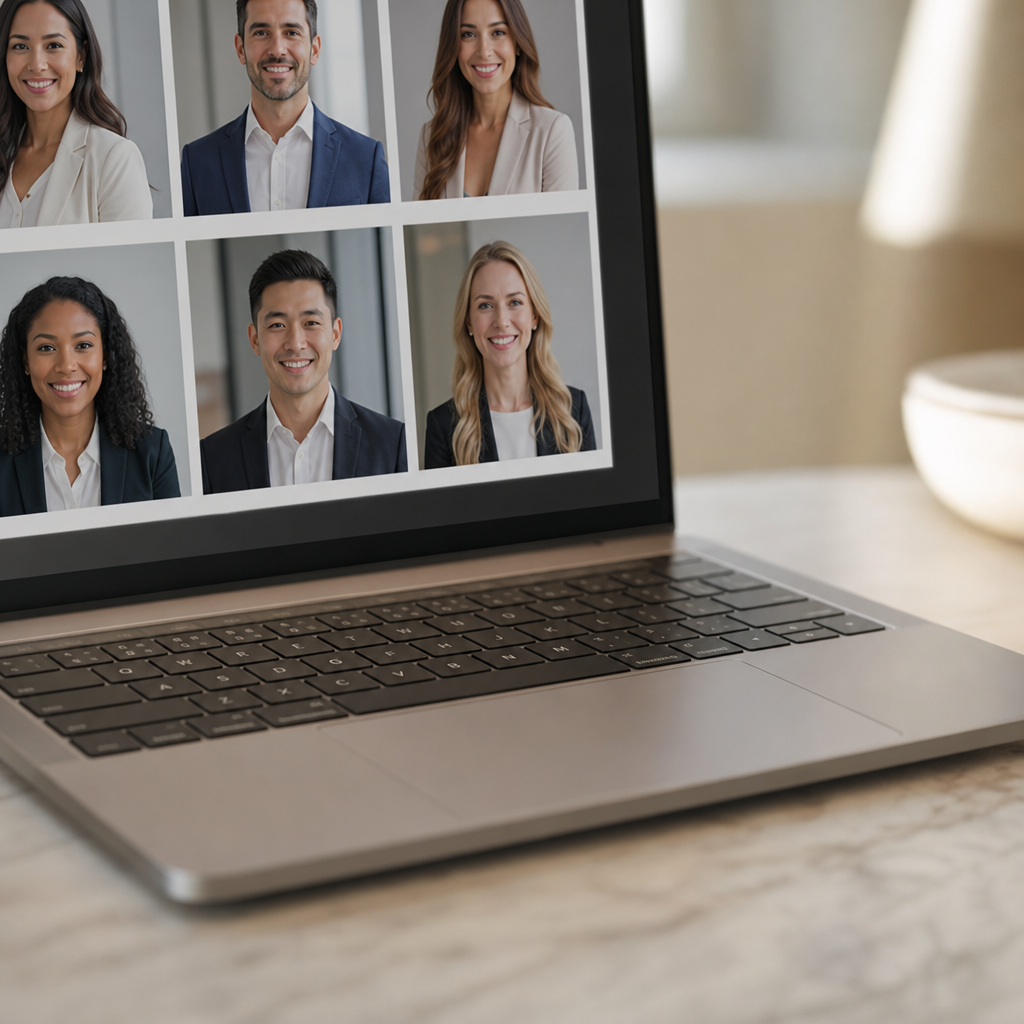
AI headshot platforms have addressed this with something close to elegance: a shared style template — same background, same lighting treatment, same color grading — applied individually to each team member's own uploaded selfies, regardless of where they're sitting in the world. A remote-first company with employees in Austin, Nairobi, and Manila can, in an afternoon, produce a leadership page that looks like everyone stood in the same studio on the same day. Headshot Lab's team packages lean into exactly this use case, letting HR and marketing teams specify a consistent attire and background standard that scales across dozens or hundreds of employees without a single camera being unpacked.
There's a reputational dimension here too. Consistency in team photography signals organizational coherence in a way that's almost subliminal — a visual cue that this is a company that has its act together, even if the deeper truth is messier, as it always is. A Fast Company piece on remote-work branding noted that distributed companies, lacking the built-in cohesion of a shared physical office, often over-invest in these smaller signals of unity precisely because they can't rely on the osmotic bonding of shared hallways and lunch rooms. A matching set of headshots becomes a small act of culture-building, almost sartorial in function — the professional equivalent of a team uniform, assembled not in a locker room but through a web upload.

The Face as First Draft
What's genuinely novel about this moment isn't the technology alone — generative AI has been reshaping creative industries broadly for several years now, as outlets from The Atlantic to specialist design publications have chronicled extensively. What's novel is the intimacy of the application. A headshot isn't a marketing banner or a piece of concept art; it's a stand-in for your actual face, deployed in contexts — job applications, investor decks, press kits — where trust and authenticity carry real weight. The willingness of millions of professionals to let an algorithm render that face has required a recalibration of what authenticity even means in a professional context. Nobody believes the blurred bookshelf is real. Everyone accepts it anyway, the same way nobody believed the painted backdrop in a 1988 school photo was an actual meadow.
Perhaps the better way to think about it is that the AI headshot isn't a replacement for the photographed self so much as a professional first draft — a way of presenting the version of yourself that exists on your best day, under your best light, in your most put-together outfit, without needing all three of those things to align on the same Tuesday afternoon. Traditional portrait photography never claimed to capture some raw, unmediated truth either; a skilled photographer has always been, in part, a lighting technician and a flatterer. The algorithm has simply absorbed that flattery into its training weights and made it available on demand, at a scale and price point that puts it within reach of nearly anyone with a smartphone and twenty minutes to spare.
There is, inevitably, a generation of hiring managers and recruiters developing a practiced eye for the telltale signs — the slightly too-perfect symmetry, the background that's just a touch too soft, the blazer that doesn't quite drape the way fabric drapes under gravity. But as the technology matures, that eye will likely need to get sharper every year, the gap between the generated and the genuinely photographed narrowing until the distinction stops mattering to anyone except the technically curious. The question will shift, as it tends to with every new tool that handles self-presentation, from "is this real?" to "does this person, broadly, look like this?" — a bar that a well-made AI headshot now clears with some consistency.
What remains is the strange, very modern intimacy of sitting alone with your laptop, choosing which version of your professional self to send out into the world — picking a blazer you'll never iron, a background you'll never stand in, under light that exists only as math. It is, in its own understated way, one of the more honest things about the whole exercise: everyone has always curated the face they show the world before they say a word. The tools have simply gotten faster, and more people now get to use them. Somewhere between the old studio with its gray backdrop and the glowing laptop screen, a woman in Minneapolis closes her browser tab, satisfied, and goes back to her Tuesday — a little more visible to the world than she was an hour before, her new portrait already quietly doing its work on headshotlab.com and, soon, on a hundred other screens she'll never see.
Article written by FrontRank