 HEADSHOTLAB
Is It Time to Rethink What a Headshot Generator App Can Actually Do?
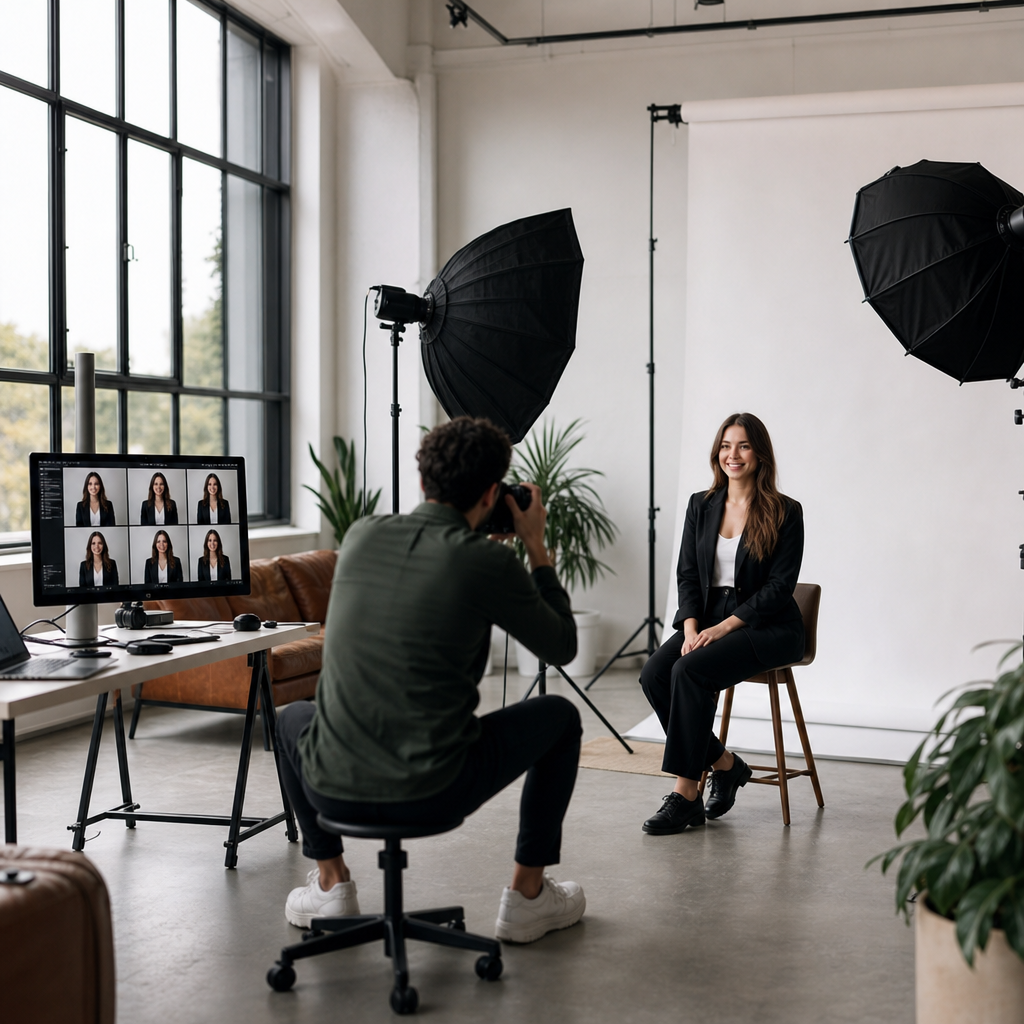
There is a particular kind of light that used to mean something. Softbox light, bounced off a white umbrella in a rented studio somewhere between a dry cleaner and a nail salon, the kind of light a receptionist might book you into on a Tuesday afternoon between client calls. For decades, that light was the price of admission to looking credible. If you wanted a headshot that said "trust me with your portfolio" or "hire me for this director role," you paid for the light, the photographer who knew how to use it, and the three hours you'd never get back.
That economy is quietly dissolving. Not with the drama of disruption-speak, but with the mundane efficiency of a phone camera, a decent window, and an app that has learned, with unnerving precision, what studio light looks like. The headshot generator app has become one of those technologies that arrived without much fanfare and then turned out to have rearranged an entire small industry while nobody was watching the obituary column.
The Studio Was Never the Point
It's worth pausing on what people were actually paying for when they booked a headshot session. It wasn't really the photographer's finger on the shutter. It was certainty—the assurance that the lighting would be even, the background appropriately blurred, the jawline neither harsh nor mushy, the overall effect calibrated to read as "serious professional" rather than "person who just woke up." Photographers like Peter Hurley built entire careers teaching other photographers how to manufacture that specific certainty, codifying the squinch and the jib-arm lean into something close to a formula. The formula worked. It also cost, in most American cities, somewhere between two and six hundred dollars for a session that produced a handful of usable frames.
What the current generation of AI tools has done is take that formula—lighting ratios, lens compression, the particular blur gradient of an f/2.8 portrait lens—and encode it into a model that can apply it to an existing photograph of a face. You are no longer paying someone to recreate the formula in a room with you. You are paying for the formula itself, applied computationally to a selfie you already have. LinkedIn's own research on recruiter behavior has long shown that profiles with photographs receive dramatically more views than those without, and that the quality of that photograph does measurable work in a stranger's snap judgment. The incentive to look polished never went away. Only the mechanism for achieving it has changed.
Services such as Headshot Lab sit squarely in that gap between incentive and mechanism. A user uploads a set of ordinary photographs—nothing staged, often just whatever exists on a phone from recent months—and chooses attire, background, and a general stylistic register: corporate, creative, editorial, casual-but-credible. Within a short window, usually minutes rather than days, the system returns dozens of variations, each one built from the same underlying face but dressed, lit, and composed differently. The user picks favorites, spends retouch credits on fine adjustments, and walks away with images that would have previously required an entire Saturday and a car trip across town.
The Uncanny Valley Has Moved
Early AI-generated imagery had a tell. Hands with six fingers, earrings that didn't match, teeth that looked slightly too uniform, backgrounds that dissolved into abstraction at the edges. Anyone who spent time in 2022 and 2023 scrolling through experimental AI art understood the valley intimately—images that were almost right in a way that made them feel more wrong than something crudely drawn. That valley hasn't disappeared, but it has moved, and for headshots specifically, it has narrowed to the point of near-invisibility for casual viewers.
The reason is structural. Headshots are a much more constrained problem than general image generation. A face, forward-facing or at a slight angle, against a limited set of plausible backgrounds, wearing clothing drawn from a relatively narrow set of professional archetypes—blazer, button-down, quarter-zip, the occasional statement blouse. Constrained problems are exactly what machine learning models solve well. MIT Technology Review has covered this pattern repeatedly: generative models tend to excel precisely where the possibility space is bounded, and headshots, for all their personal stakes, are bounded in a way that a fantasy landscape or a hand gripping a coffee cup simply isn't.
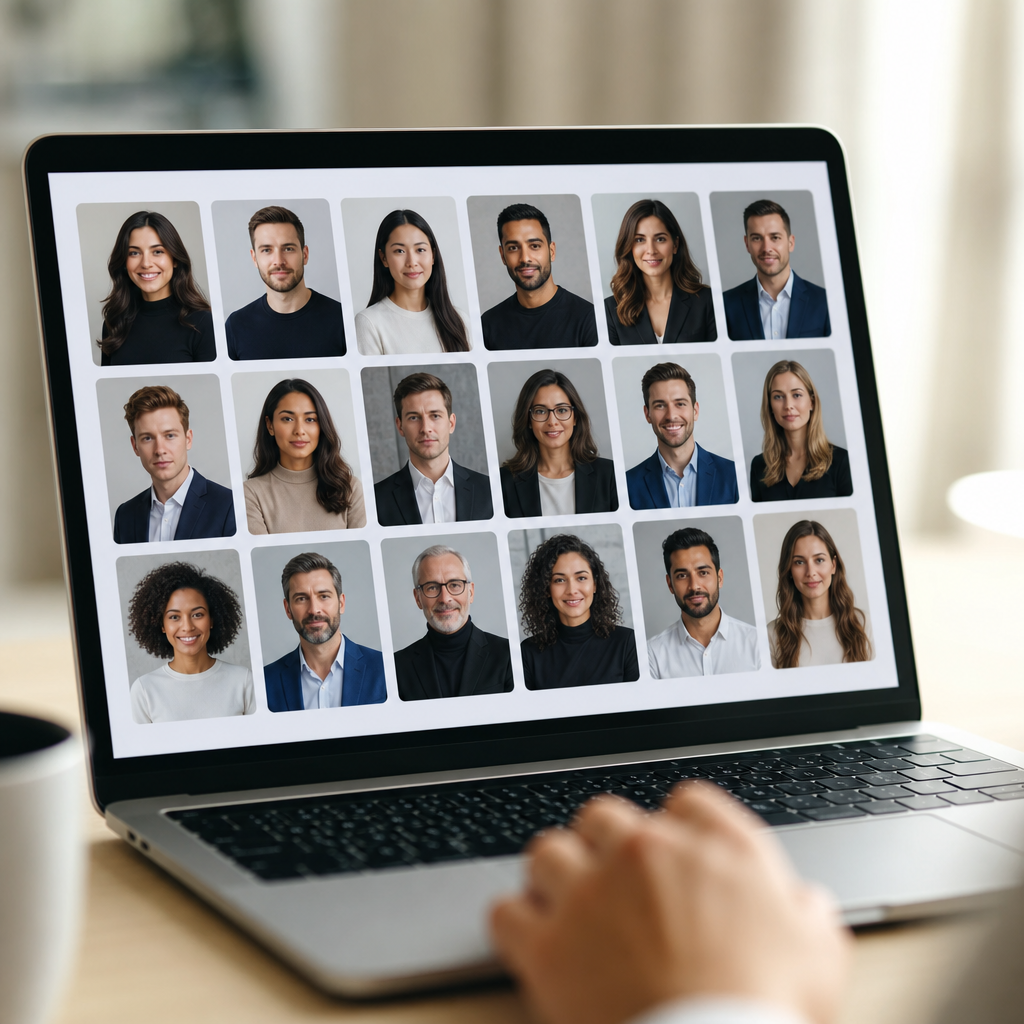
This is why the better headshot generator app tools now produce images that pass a test almost nobody thought to articulate a few years ago: the coworker test. Would a colleague who has sat across from you in dozens of meetings glance at the image and sense something was off? Increasingly, the answer is no. The skin texture retains pores. The eyes carry the particular asymmetry that makes a face recognizably yours rather than a smoothed average. The jacket drapes the way jackets drape on shoulders, not the way a costume designer imagines they should. Companies like Headshot Lab have built their retouch-credit systems around exactly this nuance—because the last five percent of realism is where trust lives, and no fully automated process gets there without a feedback loop that lets a real person say "the collar sits wrong" and have the system actually listen.
Who Is Actually Standing in Front of the Camera
The people turning to these tools are not, for the most part, vain or lazy, despite what a certain strain of commentary likes to imply about anything involving AI and appearance. They are a remote software architect in Austin who has not seen the inside of an office in four years and has no reason to own a blazer, let alone wear one for a photographer. They are a graduate student finishing a dissertation who needs a credible LinkedIn photo for the academic job market and has, understandably, spent her limited funds on conference travel rather than portraiture. They are a career-changer in her fifties re-entering a job search after a long stretch in a single role, aware that the photo on her last resume is a decade and a hairstyle out of date, and unwilling to spend a week's grocery budget finding out what she looks like now under studio light.
And increasingly, they are organizations. A twelve-person startup that just closed its first serious funding round and needs a "team" page that doesn't look like a set of candid vacation photos. A distributed consultancy with employees across four time zones who will likely never be in the same city, let alone the same studio, yet need headshots consistent enough that the company website doesn't look like a ransom note of mismatched styles. Harvard Business Review has written at length about the quiet signaling function of corporate visual consistency—the way a unified look across a leadership team communicates organizational coherence even when nothing substantive about the company has changed. A headshot generator app that can apply the same background and dress code across forty different faces, without forty different travel itineraries, solves a logistics problem that used to simply be accepted as unsolvable for distributed teams.
This is where the team-package model, which services like Headshot Lab have built out alongside their individual offering, becomes genuinely interesting rather than merely convenient. The old method for achieving team consistency involved flying a single photographer to a single location on a single day, which meant that remote-first companies—now a substantial share of the knowledge economy, per Gallup's ongoing workplace research—were structurally excluded from the kind of visual polish that in-office companies took for granted. The new method removes the location constraint entirely. Forty employees in forty cities can each submit their own photos from their own homes and receive back images with matching backgrounds, matching lighting registers, and a shared sense of occasion, without ever being in the same room.
The Ethics Nobody Wants to Skip Past
It would be a thin piece of writing that pretended this shift arrives without friction. The most honest conversation happening around AI-generated headshots concerns authenticity—specifically, whether an image that has been substantially reworked by software constitutes a form of misrepresentation, particularly on a platform like LinkedIn where the photo functions as a proxy for "this is what you'd see if we met." The Verge and other outlets covering the early wave of AI headshot apps in 2023 noted the discomfort some users felt when colleagues couldn't tell whether a given image was generated or simply well-photographed—a discomfort less about the technology itself than about the blurring of a category that used to be unambiguous.
The more thoughtful operators in this space have taken that discomfort seriously rather than dismissing it. The distinction that seems to be emerging, gradually, as a kind of informal professional norm, is between enhancement and invention. A tool that takes your actual face, your actual bone structure, your actual expression, and dresses it in better lighting and more appropriate attire is doing something categorically different from a tool that invents a face that resembles you loosely, the way a caricature resembles its subject. The former is closer to what a skilled photographer and retoucher already did for decades—correcting blemishes, adjusting color temperature, smoothing a stray hair—just compressed into software and made available without the overhead. The latter would genuinely be a form of deception, and it's notable that the services building reputations for trustworthiness, Headshot Lab among them, lean hard into the money-back guarantee and multiple-option model specifically because it keeps a human being—the actual subject—in the loop as final arbiter of whether an image still looks like them.
There's a useful parallel in how the photography world itself absorbed digital retouching a generation ago. Photoshop did not destroy portrait photography's credibility; it recalibrated audience expectations about what "a photograph" implicitly includes. Nobody today assumes a magazine cover is unretouched. The emerging expectation around AI headshots may land in a similar place: not that the image is a literal, untouched capture, but that it represents a faithful, flattering, professionally calibrated version of a real person, generated through a process that is understood to exist rather than hidden. Transparency about the method, rather than the method's mere existence, appears to be what actually matters to most people's sense of whether something is honest.

What Gets Lost, and What Doesn't
It would be dishonest to pretend nothing is lost in this transition. There is a particular kind of unrepeatable moment that happens in a good photographer's studio—a genuine laugh caught between poses, an expression that emerges because a skilled photographer knew exactly what to say to provoke it. No software, however sophisticated, generates that moment; it can only work with whatever expression already exists in the source photos a user uploads. This is why the people who get the best results from any headshot generator app tend to be the ones who understand this asymmetry: they don't upload their most guarded, camera-aware photos. They upload the ones where something in their actual face is doing something true—caught mid-laugh at a dinner, relaxed on a walk, genuinely present rather than performing presence—and let the software handle the lighting, the attire, and the background, while the humanity of the expression does the work it was always doing.
This is also, incidentally, why the traditional portrait studio is unlikely to disappear entirely, in the way film photography didn't disappear when digital arrived but instead became a smaller, more deliberate, more expensive choice for people who wanted something specific from the process itself. Executive portraits for an annual report, a founder's image for a book jacket, the kind of photograph meant to last twenty years on an office wall—these will likely continue to justify the old economy of time, light, and a photographer's particular eye. What the headshot generator app has absorbed instead is the enormous middle tier: the LinkedIn photo, the team page, the press kit headshot, the conference speaker bio image, the thousand small professional moments that used to require disproportionate effort relative to their stakes. Forbes coverage of remote work's visual culture has noted repeatedly that professionals now maintain more public-facing images across more platforms than at any point before, simply because professional life itself has become more visually documented—more video calls, more platform profiles, more digital-first first impressions. The demand for competent professional photography multiplied exactly as the traditional supply chain for it became least convenient to access. Something had to give, and it was the studio visit, not the demand.
A Face Worth Trusting
What remains constant, through all of this, is the oldest fact about a headshot: it is never really about vanity. It's about trust, extended at a distance, to someone who hasn't yet earned it in person. A hiring manager scrolling LinkedIn profiles, a potential client glancing at a company's about page, a conference attendee deciding which breakout session to join based partly, absurdly, on which speaker's photo looks most approachable—these are small, fast, largely unconscious judgments, and they happen whether or not we think they should. A good photograph doesn't manufacture competence that isn't there. It simply removes a layer of friction between a real, capable person and the stranger trying to decide, in under two seconds, whether to keep scrolling or keep reading.
Standing in front of a bathroom mirror with a phone held at arm's length is, by any traditional measure, an undignified way to produce a professional photograph. And yet increasingly, it is exactly how these photographs begin—not because standards have lowered, but because the distance between an ordinary phone camera and a professional result has collapsed, handled now by software that studied the old studio formula closely enough to reproduce its essential honesty without the overhead that always surrounded it. The umbrella light, the three-hour appointment, the forty-dollar parking validation—these become optional rather than required, remembered the way people remember darkrooms: fondly, a little nostalgically, and without much desire to go back. Somewhere in that ordinary bathroom light, a version of a face that was always there simply gets noticed properly for the first time, and a tool like Headshot Lab exists, in the end, to make sure it gets seen.
Article written by FrontRank