 HEADSHOTLAB
The Entire Floor, Same Light: What Happens When One Company Hands Every Employee a Corporate Headshots AI Generator

There used to be a day for it. Someone from HR would send a calendar invite three weeks out, block a conference room nobody liked—the one with the flickering light near the window—and a photographer would arrive with two softboxes, a collapsible backdrop the color of weak coffee, and a clip to hold the drape taut against the wall. Employees would file in on their lunch break, tug at collars, ask if they had something in their teeth. The resulting photos, filed into a shared drive labeled "Headshots_FINAL_v3," would outlive entire org charts. People would leave the company and the photo would remain on the website for another eighteen months, a kind of corporate ghost.
That ritual is disappearing, not with announcement but with attrition, the way landlines did. In its place: a browser tab, a handful of selfies taken in whatever light was available that morning, and an algorithm that returns, within minutes, several dozen images that look uncannily like a person who had a very good hair day and an excellent photographer. The corporate headshots AI generator—once a novelty discussed with a raised eyebrow—has become, by late 2026, simply how a meaningful share of the professional world gets its picture taken.
This is not a small shift. A headshot is one of the few images most adults actively choose to represent themselves to strangers—to a hiring manager scrolling LinkedIn, to a journalist searching a press kit, to a client sizing up a consultant before the first call. It is a genre with its own unspoken grammar: the three-quarter turn, the soft key light, the background blurred just enough to suggest competence without ostentation. What's changed is not the grammar. What's changed is who—or what—is fluent in it.
The Studio That Fits in a Pocket
Traditional headshot photography was never really about the photograph. It was about access—to decent light, to a photographer who understood how to flatter a jawline, to the forty-five uninterrupted minutes required to try on three outfits and relax enough that you didn't look like you were being deposed. That access was unevenly distributed. A photographer in Manhattan or London might charge several hundred dollars for a session; a founder in a smaller city, or an engineer working remotely from a town with no commercial photography studio at all, often made do with whatever a friend could capture on a phone against a bookshelf.
The AI headshot generator collapses that geography entirely. Pew Research Center's data on remote work shows that a substantial share of American professionals now work at least partly outside a traditional office, often in places with little access to the kind of boutique photography studios once concentrated in major business districts. For this cohort, a service like Headshot Lab doesn't just save money—it closes a gap that geography created. Upload a set of selfies, select an attire style, a background, a mood, and within minutes the system returns a range of polished options, the way a photographer might present contact sheets after a shoot, except there was no shoot, no studio rental, no need to leave the house.
The technical machinery behind this is genuinely sophisticated—diffusion models trained to understand lighting, skin texture, and facial geometry with a fidelity that would have seemed implausible even three years ago. MIT Technology Review has tracked the rapid maturation of generative image models, noting how quickly the uncanny-valley artifacts of early AI portraiture—the smeared ear, the extra tooth, the eerie symmetry—have been engineered away. What remains is something closer to portraiture than synthesis: a face that is unmistakably the person's own, dressed in the visual language of professionalism.
The Etiquette of a New Kind of Photograph
There's a particular discomfort some people still feel admitting they used an AI generator for their headshot, as though it were a kind of cosmetic procedure best left undisclosed. This reticence says more about the newness of the technology than about any actual deception. A headshot has never been a documentary photograph in the strictest sense—it has always been curated, lit, retouched, chosen from dozens of near-identical frames because the eyes were open and the smile looked natural rather than performed. The traditional headshot photographer's entire professional value proposition was essentially: I will use my skill to make you look like the best, most rested version of yourself. An AI generator does the same work, just without the studio rental.
What has shifted is the speed and democratization of that curation. Where a photographer might deliver fifteen final images after a two-hour session, platforms like Headshot Lab commonly return dozens of style variations—different backgrounds, different attire, different expressions—allowing the user to choose the version that feels most like them, rather than accepting whatever the photographer happened to capture in the usable light. This is less a diminishment of authenticity than an expansion of agency. The subject, not the photographer, now holds the editorial control.
There is a cultural echo here worth noting. The Atlantic has written at length about how digital tools have repeatedly reshaped the terms of professional self-presentation, from the rise of the personal website in the early 2000s to the LinkedIn profile as a kind of mandatory public resume. Each tool shift provoked a similar unease—was this still "real"?—before settling into unremarkable convention. The AI headshot seems destined for the same trajectory: suspicious novelty, awkward adolescence, quiet ubiquity.
Dressing a Hundred People the Same Way, Without a Fitting Room
If the individual headshot is a small act of self-presentation, the team headshot is an act of institutional storytelling. A law firm's "People" page, a startup's about-us section, a consultancy's press kit—these are meant to project cohesion, a sense that the people pictured belong to the same enterprise and share its values, even if they've never been in the same room. Achieving that visual consistency through traditional means is logistically brutal. It requires flying a photographer to multiple offices, or flying employees to one, coordinating a dress code, matching lighting setups across days or weeks, and hoping nobody changes jobs before the website update ships.
Organizations have long understood the reputational cost of getting this wrong—the staff page where half the photos are crisp studio portraits and half are cropped conference-badge snapshots, a visual tell that undermines the polish a company is otherwise trying to project. Harvard Business Review has examined how visual consistency functions as a subtle but real signal of organizational competence, the same instinct that leads companies to obsess over font choices and brand color palettes. A mismatched headshot gallery reads, fairly or not, as a company that doesn't sweat details.
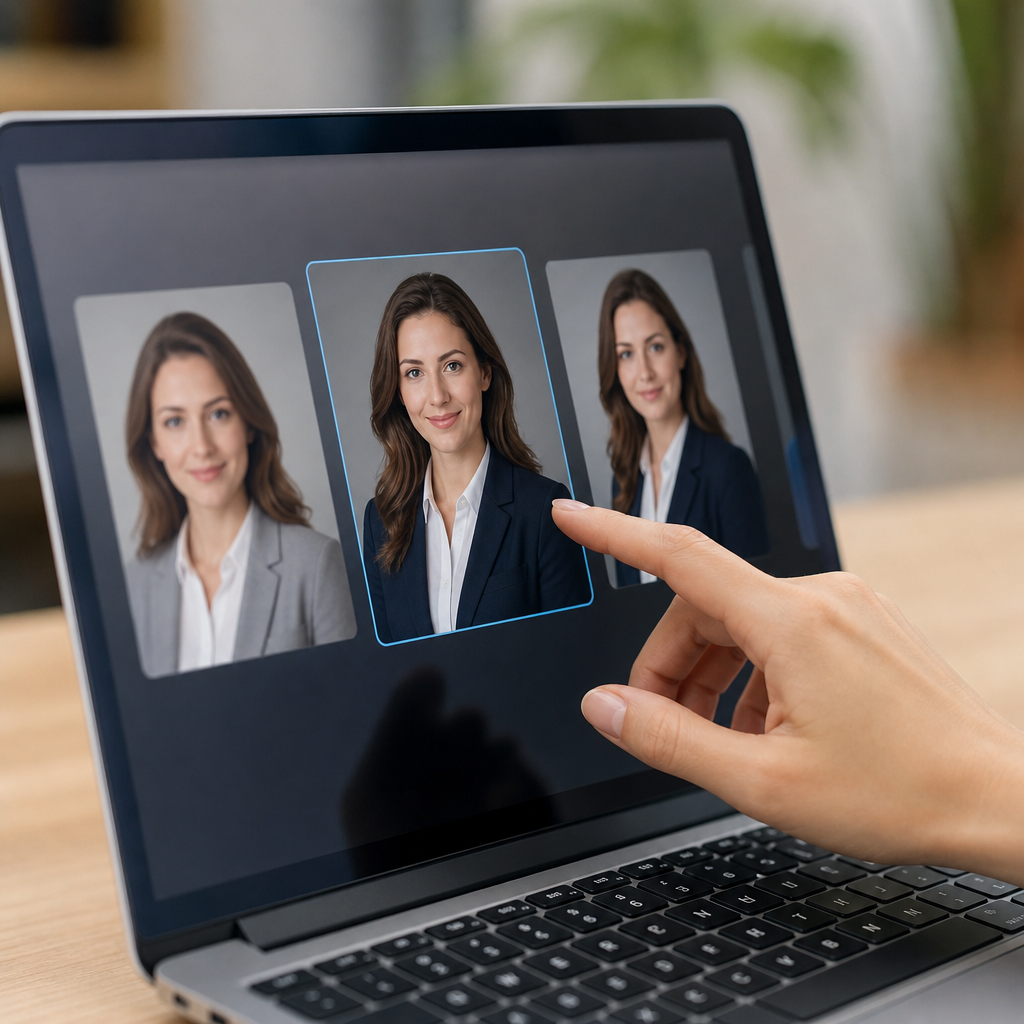
Team packages built around a corporate headshots AI generator solve this with a kind of brute elegance: every employee, regardless of location or time zone, uploads their own selfies and receives a headshot rendered against the same background, in the same attire style, under the same simulated lighting, without ever occupying the same physical space. Headshot Lab's team offering reflects this shift directly, letting distributed organizations—the hundred-person startup with employees across four countries, the nonprofit board scattered across time zones—achieve the kind of visual cohesion once reserved for companies with the budget and logistics to fly a single photographer around the world.
There is something almost theatrical about this uniformity-without-presence: a hundred people who have never stood in the same room, dressed identically, lit identically, appearing on a single page as though they'd spent the afternoon together in a studio. It is a new kind of corporate portraiture, closer to how a design studio might standardize a logo across every regional office than to how a photographer once documented a single sitting.
What the Face Is Asked to Prove
A headshot carries more cultural weight than its modest dimensions suggest. Harvard Business School research on first impressions has repeatedly found that hiring decisions and even perceived competence are shaped within milliseconds of seeing a photograph, long before a résumé is read in full. LinkedIn itself has published data suggesting profiles with professional photographs receive dramatically more views and connection requests than those without. The stakes attached to this small rectangle of pixels are, in practice, considerable—disproportionate, perhaps, to what a photograph can actually reveal about a person's ability to do their job, but real nonetheless.
This is partly why the anxiety around the traditional headshot session was never really about vanity. It was about performance under observation—the particular tension of being told to "just relax" by someone holding a camera, in a room designed for the express purpose of capturing you at your most composed. Removing that observer from the equation changes the psychology of the photograph considerably. A person taking selfies alone, in their own light, on their own schedule, tends to produce a more unguarded set of source images than one sitting rigid in a photographer's studio chair. The AI generator's job, then, is to take that unguarded rawness and translate it into the visual register of professionalism—the register the viewer expects—without flattening what made the original expression genuine.
This is the quieter achievement of services built around transformation rather than fabrication: they aren't inventing a face from a prompt, the way a purely generative portrait tool might conjure a person who doesn't exist. They're working from real uploaded photographs, preserving the actual bone structure, the actual asymmetries, the gap in the teeth or the single stray gray hair, and restyling the context around them—the lighting, the attire, the backdrop—while leaving the person legible as themselves. The distinction matters enormously to users, many of whom have said, in the kind of unprompted testimonial that marketing departments dream of, that the result looked more like them than their own phone camera ever had, simply because the light was finally doing its job.

The Trust Question, Answered in the Fine Print
No new technology arrives without a credibility tax, and AI-generated imagery has paid more of that tax than most, thanks to a parallel universe of deepfakes, synthetic influencers, and manipulated video that has made "AI-generated" sound, to a skeptical public, uncomfortably close to "AI-fabricated." The Federal Trade Commission has issued guidance on deceptive AI practices, a reminder that transparency isn't optional when algorithms are involved in representing real people. The companies that have earned trust in this specific, narrower corner of AI—turning a real selfie into a real, if stylized, professional photograph—have generally done so by being unusually candid about the mechanics and unusually generous with the guarantees.
This is where the details that once seemed like unremarkable customer-service boilerplate—retouch credits, money-back guarantees, the ability to regenerate a batch that didn't land—start to matter culturally as much as commercially. They are, in effect, a trust infrastructure built to compensate for the discomfort of not having a human photographer in the room vouching for the final product. Headshot Lab's model, which pairs a one-time fee with dozens of style options and the ability to request retouches if the first results miss the mark, mirrors the logic of the old photography studio's proof sheet: you don't commit to a single image sight unseen, you choose from a range, and if none of it works, there's recourse. That structure does more to build confidence in the category than any amount of marketing copy about neural networks could.
There's also a quieter form of trust-building happening in how these tools are being written about. Outlets like Wired and Fast Company have covered the AI headshot boom not as a gimmick but as a legitimate inflection point in how professional identity gets manufactured and distributed online, treating it with the same seriousness once reserved for the rise of video resumes or the shift from print to digital portfolios. That kind of sober coverage, arriving alongside the technology's steady technical improvement, has done more to normalize the category than any single company's claims about accuracy could.
A Face for the Algorithmic Age
It is tempting to read the rise of the AI headshot purely as a story about convenience—cheaper, faster, no need to leave the house—and that story is certainly true as far as it goes. But there's a more interesting undercurrent here, one about who gets to control the terms of their own professional image. For decades, the quality of your headshot was largely a function of your budget and your zip code: proximity to a good photographer, money for a good suit, time for a proper session. The corporate headshots AI generator flattens much of that hierarchy. A freelancer in a small town and a managing director in a glass tower can, for the first time, arrive at the same baseline of visual polish, working from the same raw material—a phone, decent daylight, and a few minutes of patience.
That leveling effect extends to organizations too. A ten-person nonprofit can now present a team page with the same visual coherence as a Fortune 500 company's investor relations site, not because it has the budget to fly a photographer to ten different homes, but because the tool doesn't care where anyone is sitting when they take the source photo. This is, in its own understated way, a genuinely democratizing development—one of the few instances of an AI tool narrowing a gap rather than widening it.
What remains constant, through all of this, is the purpose the image is meant to serve: a stranger, scrolling quickly, forming a first impression in less time than it takes to read this sentence. The lighting, the backdrop, the choice between a blazer and an open collar—these are details that matter because the viewer's brain, evolved for reading faces long before it learned to read résumés, will make its judgment regardless of how the photograph was produced. Whether a studio flash or a trained algorithm did the work of flattering that judgment has, increasingly, stopped being the question anyone outside the industry asks.
The conference room with the flickering light still exists, somewhere, in some office that hasn't updated its policies. But the appointment calendar for it has mostly gone quiet. In its place is a browser tab open at midnight, a person choosing between a navy blazer and a charcoal one, a background that looks like a window onto a city they've never actually worked in, and a result that will sit at the top of their LinkedIn profile for the next two years, doing the same quiet work headshots have always done—vouching for someone before they've had the chance to speak. Sites like headshotlab.com didn't invent that function. They just found a faster, more accessible way to perform it, one selfie at a time.
Article written by FrontRank