 HEADSHOT LAB
The Boardroom Light You Never Stood Under: Inside the Age of AI Headshots
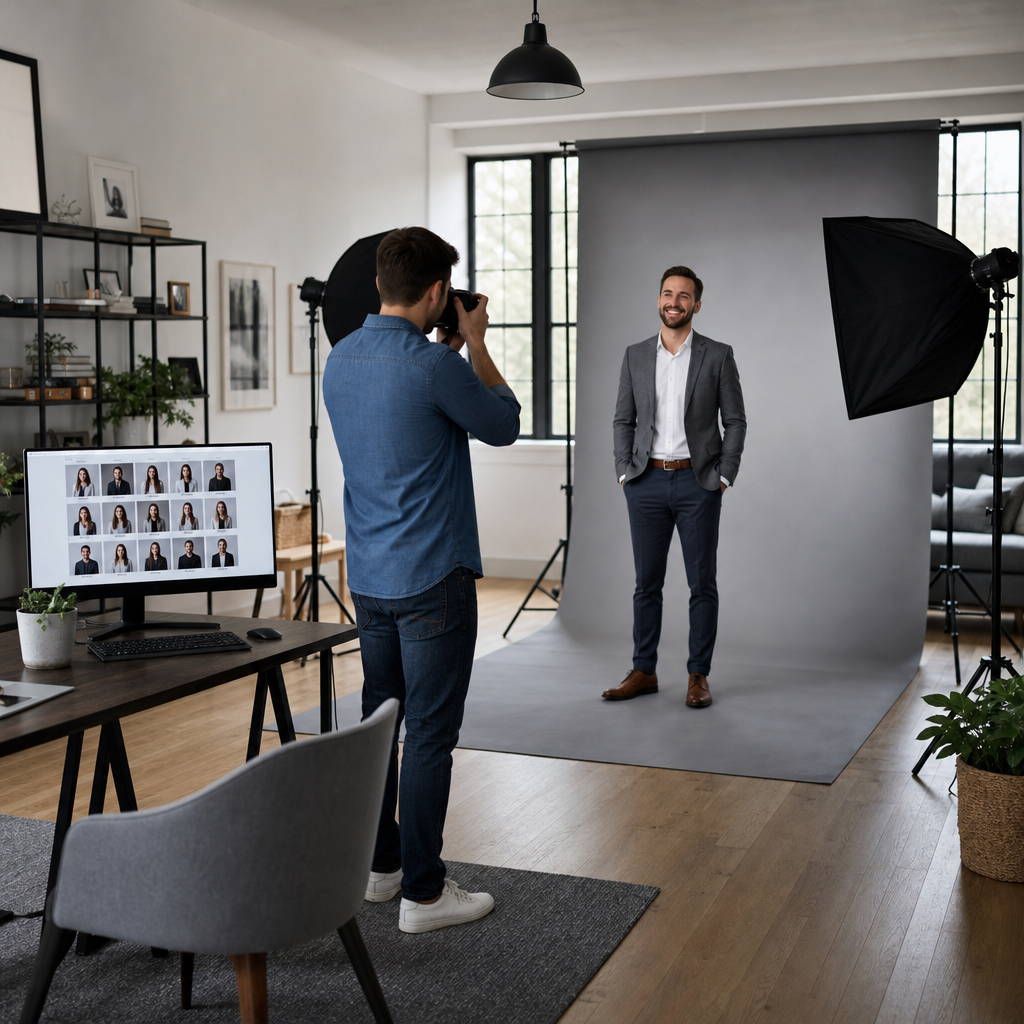
There is a particular quality of light that has, for decades, signalled professional legitimacy. It falls at a forty-five degree angle, soft but directional, the kind a photographer spends an hour rigging with umbrellas and a grey seamless backdrop before you ever sit down. You know the look even if you've never been inside a studio: the gentle gradient behind the shoulder, the faint catchlight in the eye, the sense that somewhere off-camera a professional with a light meter decided you were ready. For most of the twentieth century, that light belonged to executives, actors, and politicians. Now it belongs to anyone with a laptop, a decent selfie, and twenty minutes to spare.
This is the quiet transformation sitting behind the rise of AI headshots—not simply a cheaper way to get a LinkedIn photo, but a redistribution of an aesthetic that used to cost hundreds of pounds and an afternoon off work. The technology itself is almost beside the point. What matters is what it has done to the psychology of self-presentation: the boardroom light is no longer rationed.
The Studio That Never Closes
Walk into any professional photography studio in a city like London, New York, or Austin, and you'll find a familiar choreography. A stylist fusses with a collar. An assistant checks exposure on a tethered laptop. The photographer murmurs encouragement—chin down, shoulders back, now relax—while the subject tries, usually with limited success, to look like someone who relaxes for a living. It is a slightly absurd ritual, and an expensive one: a single polished headshot from a reputable studio often runs well past £200 in the UK, more in Manhattan, with hair and makeup as an add-on and a two-week turnaround for retouching.
That cost structure made sense when headshots were occasional—something you got once for a passport-style corporate portrait, then lived with for five years until the photo visibly aged out of sync with your face. But the way we present ourselves professionally has changed faster than the old model could keep up with. A single person might now need a sharp, current photo for LinkedIn, a slightly different crop for a company "About" page, a warmer version for a speaker bio, and something moodier for a press kit after a product launch. LinkedIn's own research has long suggested that profiles with professional photos receive dramatically more views and connection requests, which means the humble headshot has quietly become a piece of career infrastructure, not a vanity project.
Services like Headshot Lab exist because that infrastructure needed rebuilding. Upload a handful of selfies, choose attire and a background, and within minutes the system generates dozens of polished variations—dark suit against a muted office backdrop, smart-casual against brushed concrete, a warmer tone for a personal website bio. The underlying diffusion models have been trained to understand not just faces but the entire visual grammar of professional portraiture: how light should fall on a jawline, how a blazer should drape, what distance from camera reads as approachable rather than distant. It is, in effect, a studio that never closes, staffed by an algorithm that has looked at an almost incomprehensible number of professional portraits and learned what confidence is supposed to look like.
The Uncanny Valley Gets Renovated
Early AI image generation had a tell—a slightly waxy quality to skin, an extra finger, eyes that didn't quite agree with each other on where they were looking. Anyone who experimented with the first wave of AI avatar apps in 2023 remembers the uncanny results: headshots that looked like a department store portrait painting come to life, all soft-focus glamour and suspiciously perfect teeth. That version of the technology was fun for novelty avatars and useless for anything a hiring manager might actually see.
What has shifted by 2026 is precision. Modern headshot generators work from dozens of a user's own photographs rather than a single selfie, building a far more accurate model of bone structure, asymmetries, and the small imperfections that make a face recognisably a face rather than a composite. The result is less "AI-generated person" and more "this person, photographed brilliantly on their best day." Publications covering the broader AI image landscape, including Wired and The Verge, have tracked this same arc across the industry: the technology's novelty phase gave way to something more useful and considerably less creepy, as models improved at preserving identity rather than merely borrowing its outline.
There is something culturally telling in how quickly the uncanny valley criticism faded once the quality caught up. People were never objecting to the idea of an edited photograph—retouching has been part of professional photography since the darkroom era, and Richard Avedon's portrait sittings for Harper's Bazaar in the 1950s involved plenty of selective enhancement long before Photoshop existed. The objection was to bad fakery. Once the fakery became good enough to pass as simply good photography, the conversation shifted from suspicion to simple expectation. Today, nobody assumes your headshot was taken in natural light in your kitchen. They assume, correctly, that some kind of post-processing happened somewhere, whether that's a $300 photographer's retouching pass or a $40 AI session that handled lighting, background, and wardrobe in one sitting.
Who Actually Needs the Light
The audience for this shift turns out to be broader and more varied than the stock image of a tech-savvy jobseeker suggests. Consider the remote worker based in a small town with no professional photography studio within an hour's drive, who nonetheless needs a headshot sharp enough to match colleagues at a company headquartered three time zones away. Consider the recent graduate applying for consulting roles, aware that a first impression now routinely happens through a LinkedIn thumbnail before it happens in person. Consider the freelance consultant rebranding mid-career, who needs a new photo not because they look older but because their last one was taken at a friend's wedding and cropped, badly, to remove the best man.
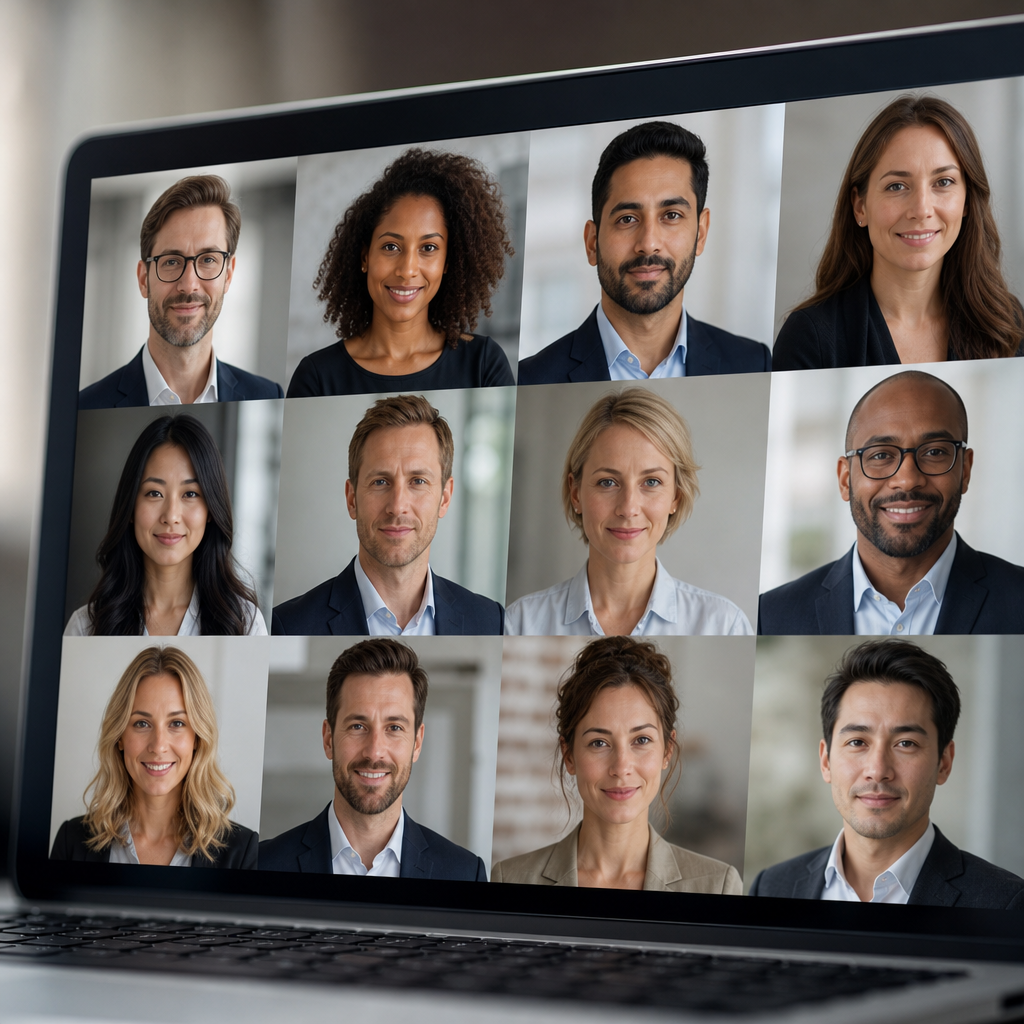
Then there is the case that has quietly become one of the more interesting applications: entire teams. A fast-growing startup bringing on fifteen new hires in a quarter faces a logistical headache that has nothing to do with technology and everything to do with scheduling—coordinating a single photographer, a single studio day, and fifteen calendars that rarely align. Harvard Business Review has written at length about how visual consistency across a leadership team or sales force subtly shapes how clients and partners perceive an organisation's cohesion; a company website where half the team photos look like a hostage negotiation and the other half look like a wedding photo creates a dissonance that undermines trust before a single sentence of copy is read. Headshot Lab's team packages address this directly, generating matching backgrounds and attire across an entire roster without requiring a single person to physically be in the same room, let alone the same city. A distributed team spanning Lisbon, Austin, and Singapore can end up with headshots indistinguishable, in tone and lighting, from a single coordinated studio shoot that never actually happened.
There's a quiet dignity in this for the people who, under the old system, simply got left out. The regional sales rep who never made it into head office for photo day. The contractor who technically isn't an employee but represents the brand anyway. The small business owner who built a company from a spare room and genuinely cannot justify flying in a photographer for a team of four. AI headshots don't just save money; they extend an aesthetic privilege that used to be rationed by budget and geography.
The Etiquette of the Edited Face
None of this has arrived without friction. There is a live and legitimate conversation, playing out across hiring forums and opinion columns, about where enhancement ends and misrepresentation begins. The New York Times has covered the broader unease around AI-altered professional imagery, noting the particular anxiety it creates in hiring contexts: if a candidate's photo has been smoothed, slimmed, and re-lit by an algorithm, does the person who arrives for the in-person interview risk feeling like a disappointment by comparison?
It's a fair question, and the more thoughtful corners of the industry have answered it not by abandoning the technology but by building guardrails into how it's used. The meaningful distinction isn't between "real" and "AI" photos—that binary collapsed the moment retouching became standard practice decades ago—but between photos that preserve a person's actual, recognisable likeness and ones that quietly manufacture a different face altogether. A good AI headshot should survive the test of a colleague glancing at it and thinking, correctly, "that's a great photo of you," rather than "I didn't recognise you." Services built around likeness preservation, generating results from a genuine volume of a person's own images rather than a generic template, tend to land on the right side of that line. The suit, the lighting, the background—these are staging. The face underneath should remain stubbornly, verifiably yours.
There is also a quieter cultural shift worth naming: the democratisation of a certain visual register of seriousness. For a long time, the polished headshot was itself a class signal—evidence that someone had the budget, the professional network, or the corporate backing to commission one. Actors have always understood this; a headshot is not a photograph so much as a piece of marketing collateral, as the trade press around Backstage has long documented in its coverage of the audition circuit, where a dated or amateur headshot can cost a performer a casting call before they ever walk into a room. What's happening now is that the same logic—your photo is doing professional work on your behalf before you arrive—has spread from actors and executives to nearly everyone with a LinkedIn profile, and the tools to meet that expectation have spread with it.
A Face for Every Room You Enter Virtually
It's worth sitting with how strange this would have sounded even a decade ago: the idea that a person might reasonably own several equally valid "professional selves," each calibrated to a slightly different room. The LinkedIn photo trends slightly warmer and more approachable, built for a platform that rewards a sense of accessibility. The company website photo sits more formally, aligned with brand colours and a background that matches fourteen other headshots on the same page. The press kit photo, for the founder doing a run of podcast interviews after a funding announcement, might lean moodier, more editorial, closer to the register of a magazine profile than a corporate directory.
Traditional photography could, of course, produce all of these—but rarely in a single sitting, and never without multiple wardrobe changes and a photographer patient enough to reset lighting three times in an afternoon. The AI approach collapses that logistical weight. A single upload session with Headshot Lab can yield dozens of variations spanning exactly this range, letting a person choose the register that suits the room they're walking into, virtually, that week. It's less like commissioning one portrait and more like having access to a portrait wardrobe—formal, approachable, editorial—without needing to re-book a studio every time the context shifts.
This matters more than it might first appear, because professional identity itself has become more fluid. Someone might be a full-time employee, a part-time consultant, and an occasional conference speaker within the same calendar year, each role demanding a slightly different visual register while remaining, unmistakably, the same person. The old headshot model assumed a single, static professional identity that got photographed once and left alone. The new one assumes multiplicity, and the tools have adjusted accordingly—retouch credits, multiple style sets, and the kind of money-back guarantee that treats a headshot less as a one-off purchase and more as a service relationship, something to be refined rather than simply delivered and forgotten.

The Afternoon You Get Back
Perhaps the most underrated benefit in all of this is the simplest: time. A traditional headshot session, door to door, tends to consume the better part of a day once travel, wardrobe changes, and waiting for the right light are factored in. For a solo professional, that's a billable afternoon lost. For a team of twenty, it's a cumulative week of productivity spent standing against a grey backdrop being told to relax. Forbes has noted the broader trend of professionals reclaiming time from tasks that technology can now compress from days into minutes, and the headshot is a particularly clean example: the output—a polished, studio-quality photograph—hasn't changed in kind, only in the friction required to produce it.
There's a version of this story that could be told cynically, as another instance of technology quietly automating away a craft. But photographers who specialise in headshots haven't disappeared; if anything, the ones doing distinctive, characterful work—the kind that captures a specific personality rather than a generic professional template—have found their services more clearly differentiated from the commodity end of the market that AI now serves well. What's been automated isn't the art of portraiture so much as the logistics of a fairly narrow, formulaic need: a clean, well-lit, current photo of your face, delivered quickly, at a price that doesn't require a line item in anyone's budget.
Standing in that renovated uncanny valley, it's worth remembering what the boardroom light was always standing in for: the suggestion that someone, somewhere, had decided you were worth the trouble of good lighting. That idea no longer requires an appointment. It requires a few photographs taken on an ordinary afternoon, and twenty minutes of patience while Headshot Lab does the part that used to take a studio, a stylist, and a calendar invitation sent three weeks in advance. The light is still there, waiting at that same flattering forty-five degree angle. It's just no longer rationed by who could afford to book it.
Article written by FrontRank