 HEADSHOTLAB
Stop Waiting for Forty Calendars to Align Before Your Team Looks Like One
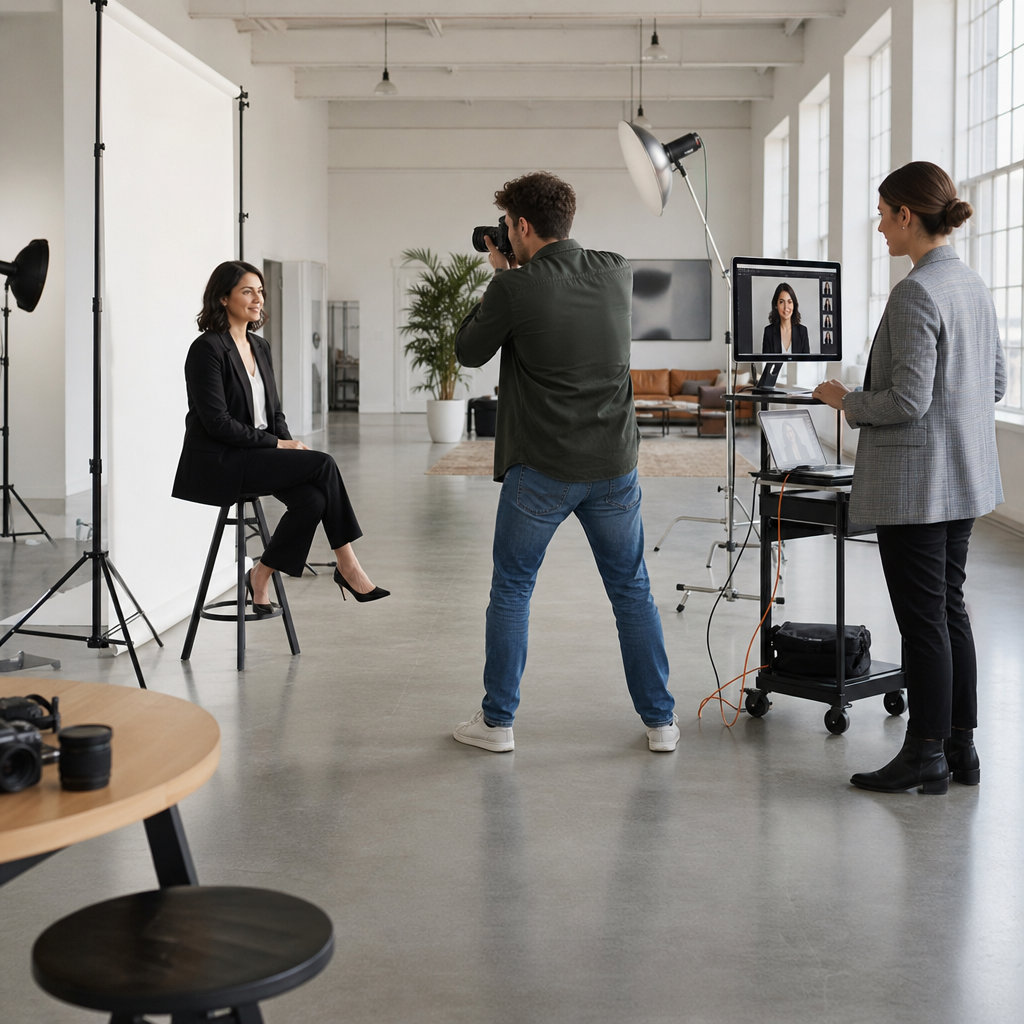
There is a particular kind of email that arrives every eighteen months or so in the inbox of anyone who has ever worked in an office with a website. The subject line reads something like "Headshot Day — Please Confirm Availability," and beneath it sits a spreadsheet, a studio address, and a plea. Someone in HR or marketing has spent weeks trying to find four consecutive hours when forty, or four hundred, people can all be free at once. Inevitably, six people are travelling. Two are on leave. One has just changed their hair and wants to reschedule. The photographer, booked at considerable expense, ends up shooting half the team in March and the other half in June, under different light, against a backdrop that has since been repainted.
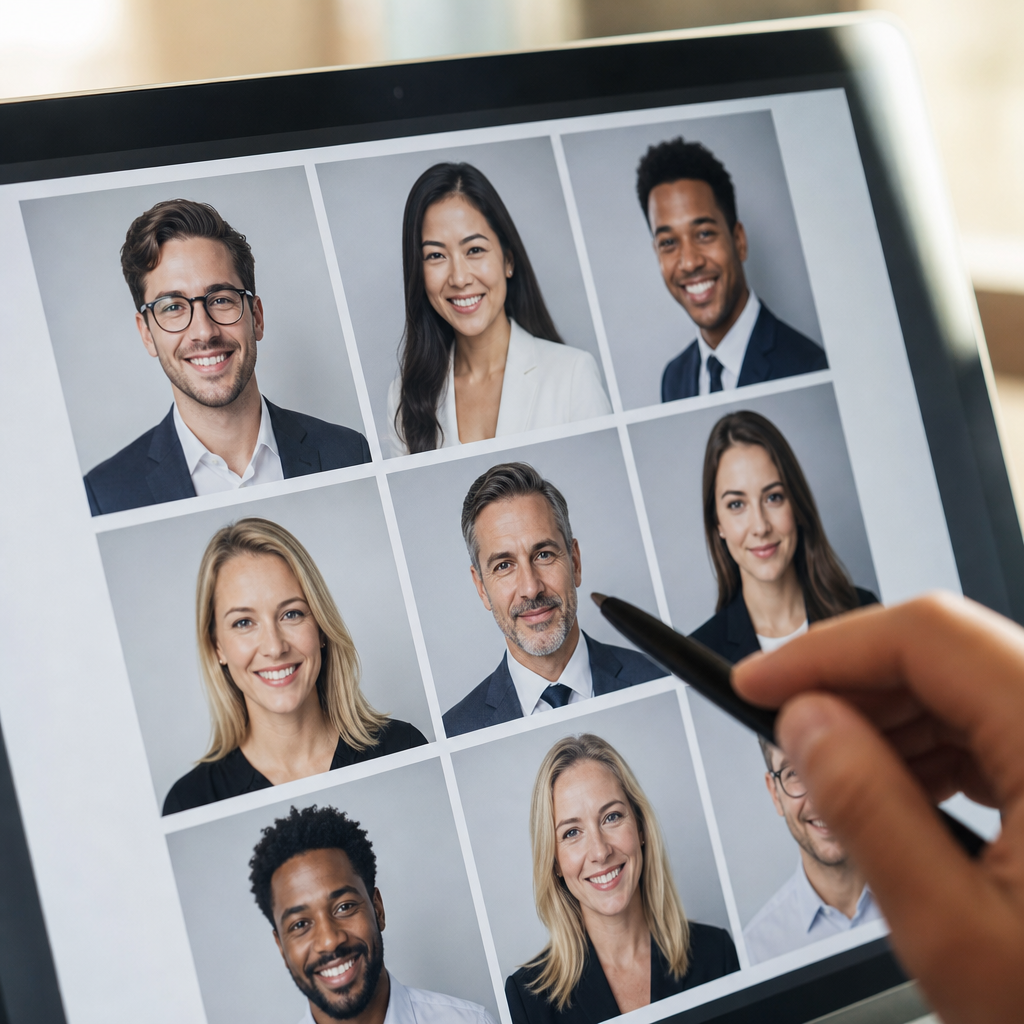
The result, visible on nearly every "Our Team" page on the internet, is a quiet visual stutter — a row of faces that don't quite belong to the same company. Some are lit warmly, some clinically. Some wear the grey backdrop of a conference room, others the blown-out white of a converted broom cupboard. It is a small thing, almost invisible until you notice it, and then you cannot stop noticing it. It is the corporate equivalent of a choir singing slightly out of time.
This is the problem that has quietly reshaped how organisations think about something as ordinary as a profile photo. And it is the problem that an AI headshot generator for teams exists to solve — not by making photography faster, but by removing the scheduling, the studio, and the geography from the equation entirely.
The Tyranny of the Shared Calendar
Anyone who has coordinated a group photo shoot will tell you that the hardest part was never the photography. It was the logistics. A professional photographer is, by the economics of the trade, an expensive and finite resource. They charge by the hour, they travel with equipment, and they need a physical space with the right light. For a company with five employees in one office, this is manageable. For a company with three hundred employees across Austin, Lisbon, and a satellite office in Singapore, it becomes something closer to a military operation.
The traditional solution was triage. Photograph whoever happens to be in the building that week. Let remote employees submit "whatever photo they have," which in practice means a cropped wedding photo, a blurry conference snapshot, or — more often than anyone likes to admit — no photo at all, just a grey silhouette icon sitting where a human face should be. LinkedIn's own research has long shown that profiles with photographs receive dramatically more views and connection requests than those without, which means that grey silhouette is not a neutral absence. It is a cost, multiplied across however many unphotographed employees a company has.
Even when the shoot does happen, consistency is its own casualty. A new hire joining in September has no way of matching the lighting setup used for a team photographed in February. The backdrop fabric fades. The photographer who did the original shoot moves cities. What was meant to be a unified visual identity becomes, instead, an archaeological record of several distinct eras of the company's history, stitched together on a single webpage.
What Changes When the Studio Becomes Software
The shift toward AI-generated headshots does not pretend to replace the craft of portrait photography — the particular skill of a photographer like Annie Leibovitz, who can coax something unguarded out of a reluctant subject in a single frame, is not something software reproduces. What it does instead is solve a different problem: the problem of producing a large volume of consistent, professional-grade images, for people scattered across time zones, without anyone needing to leave their desk.
The mechanics are almost disarmingly simple. An employee uploads a handful of selfies — ordinary phone photos, taken in whatever light their kitchen or home office happens to have. The system processes these images and returns a set of polished portraits: studio lighting, tailored or business-casual attire depending on what the organisation has specified, and a background chosen to match the company's visual identity, whether that's a neutral charcoal, a soft gradient, or a tone pulled directly from the brand's palette. Headshot Lab was built around exactly this workflow, allowing a team administrator to set the attire and background once, and have every employee's output arrive looking as though they had all stood, one after another, in front of the same camera on the same afternoon — even though no two of them were ever in the same room, or even the same country.
The appeal here is not novelty for its own sake. It is the removal of friction at every point where friction used to be expensive. There is no studio rental. No travel reimbursement for the photographer. No half-day of lost productivity while employees queue outside a conference room waiting their turn in front of a ring light. A design lead in Berlin and a sales rep in Manila can produce headshots that sit, visually, side by side — matching light, matching tone, matching polish — despite an eleven-hour time difference and two entirely different physical realities.
The Aesthetics of Belonging
There is something worth dwelling on in why visual consistency across a team matters as much as it does. It is not merely tidiness. A matched set of headshots functions, whether consciously or not, as a signal of cohesion — the same instinct that leads orchestras to dress their musicians in identical black, or that led the fashion houses of mid-century Paris to insist their house models move in the same choreographed walk. Vogue's own archives are full of examples of how uniformity of presentation, far from suppressing individuality, often throws it into sharper relief: against a consistent backdrop, what varies — the particular tilt of someone's smile, the colour of their eyes, the set of their shoulders — becomes the thing you actually see.
The same logic applies, quietly, to a company's "About Us" page. When every headshot shares the same light and the same backdrop, the viewer's attention moves past the production values entirely and lands on the faces themselves. When the backdrops clash — one person photographed against a hotel curtain, another against a laptop camera's fisheye distortion — the viewer's attention snags on the inconsistency before it ever reaches the person. Design consultancies have written at length about this effect; Harvard Business Review has published repeatedly on how visual coherence in branding functions as an unconscious trust signal, long before a customer or client has read a single word of copy.
For job seekers and individual professionals, the same principle operates at a smaller, more personal scale. A LinkedIn profile photo is often the first and only visual impression a recruiter forms before reading a résumé. The difference between a photo taken on a phone propped against a stack of books and one with deliberate studio lighting is not subtle — it is the difference between looking like someone applying for a job and looking like someone already doing one. This is part of why Headshot Lab's individual packages have found an audience well beyond the corporate buyer: the same quiet upgrade in polish that a two-hundred-person team wants in bulk is exactly what a single job seeker wants for themselves, minus the scheduling nightmare, minus the studio fee.
The Discomfort, and Why It Fades
It would be dishonest to pretend that the leap to AI-generated portraiture has been universally comfortable. There remains, among a certain cohort of professionals, a lingering suspicion of anything that smells of artifice — a sense that a headshot produced partly by software is somehow less "real" than one produced by a photographer and a flash. This is a reasonable instinct, and it echoes an older cultural unease, the same one that greeted digital retouching in magazines decades ago, before Photoshop became so ubiquitous that nobody blinked at it anymore. The New York Times has covered this discomfort as it resurfaces with each new imaging technology, from airbrushing to filters to, now, generative AI.
But the unease tends to soften once people actually see the results. The better AI headshot tools are not generating a fictional face; they are taking a real face, supplied by the user, and placing it in better light, in better clothing, against a better background — closer to what a skilled photographer and stylist would have produced anyway, if there had been the time and budget to arrange it. Headshot Lab's approach leans into this distinction deliberately: the product offers dozens of options generated from the user's own uploaded photos, along with retouch credits for anyone who wants finer control, and a money-back guarantee for anyone who simply isn't satisfied with the likeness. It is less a mask than a mirror held at better angle, under better light.
There's a useful parallel in how the beauty industry talks about restoration versus transformation — a good colourist doesn't change what your hair is, they bring out what it was trying to be under better conditions. The best AI headshots operate on the same premise. The person in the photo is unmistakably, recognisably themselves. What's different is the lighting, the backdrop, the crispness of the collar — the technical scaffolding that a professional photo shoot would have provided, now generated instead of hired.
Scaling Likeness Without Losing It
The real test of any team-wide tool is what happens at the edges — the fortieth employee, the two-hundredth, the one who joined the company three weeks ago and has never been inside its physical office. This is where the traditional photo shoot model buckles most visibly, because a photographer's calendar simply cannot stretch to accommodate rolling onboarding. A new hire starting in November has, under the old system, two choices: wait up to a year for the next scheduled shoot, or submit no photo at all.
An AI-based team system removes that bottleneck by making the "shoot" available on demand, indefinitely. The new employee uploads their selfies in the first week, receives their set of headshots within minutes, and appears on the team page, in the same style as colleagues who joined three years earlier, without anyone needing to book a studio, hire a photographer, or wait for a critical mass of new faces to justify the expense. For organisations with high turnover, contractor rosters, or distributed teams where someone is always starting or leaving, this on-demand quality is arguably more valuable than the initial bulk photography itself.
There is also a quieter financial case here that bears mentioning without dwelling on it as a sales pitch. A single half-day studio shoot for a team of fifty, including photographer's fee, studio hire, and the lost productivity of fifty people stepping away from their desks, routinely runs into thousands of dollars — figures that Forbes and other business publications have itemised when discussing the hidden costs of corporate branding exercises. An AI-based alternative, priced per person for a one-time fee, tends to undercut that figure substantially, while also solving the scheduling and geography problems that no amount of studio budget could fix anyway. It's not simply cheaper; it's solving a problem the traditional shoot structurally cannot solve, which is presence across distance and time.

A Kind of Visual Civility
What's striking, stepping back from the mechanics, is how much the whole endeavour resembles an old piece of social etiquette rather than a new piece of technology. Showing up looking presentable for a photograph — hair combed, collar straight, expression composed — has always been less about vanity than about a small act of respect toward whoever is going to look at the image afterward: the recruiter, the client, the colleague scrolling the company directory looking for a name they half-remember. An AI headshot generator for teams simply makes that small act of respect achievable at scale, without asking forty or four hundred people to clear their calendars on the same Tuesday afternoon.
There is a reason the language around these tools so often turns to words like "polish" and "consistency" rather than "transformation." Nobody is asking to look like someone else. They are asking to look, in a photograph, the way they already look on a good day, in good light, having made a small effort — the version of themselves that a skilled photographer would have found anyway, given enough time and the right studio. Headshot Lab's own positioning leans into exactly this modesty of ambition: not reinvention, but presentation, delivered quickly enough that an entire organisation can achieve it in the same week rather than the same decade.
It is worth noting, too, that the aesthetic bar for a "professional" photo has shifted meaningfully over the past few years. The slightly stiff, heavily lit corporate portrait of the 1990s — the kind framed on the wood-panelled wall of a law firm's reception — has given way to something softer, more editorial, closer to the kind of environmental portraiture favoured by publications like The Atlantic in their contributor photography. Backgrounds have softened into gradients. Lighting has warmed. Expression has loosened from the rigid half-smile of an earlier era into something closer to a candid, caught moment. AI headshot tools track this shift fluidly, offering style options that mirror contemporary portrait photography trends rather than freezing everyone in an aesthetic that peaked before most of the workforce was born.
The Room That Never Needed Booking
Picture, for a moment, the inverse of that original email — the one about Headshot Day, the spreadsheet, the studio address, the six people travelling and the one person who just changed their hair. Picture instead a Tuesday morning where a company's two-hundredth employee, newly hired, uploads four selfies from her phone before her first stand-up meeting, and by the time she joins the call, her headshot is already sitting on the team page beside her new colleagues, matched in light and tone to people she has never physically met. No studio was booked. No calendar was wrangled. No one had to leave their desk.
That image — quiet, unremarkable, almost too simple to register as a change at all — is probably the truest measure of what's happened here. The tools, platforms like headshotlab.com among them, have not made the photograph more dramatic or more artificial. They have made it available at the speed an organisation actually moves at now: continuous, distributed, and unwilling to wait a year for the next booked studio slot. The choir, it turns out, didn't need to be in the same room to finally sing in tune.
Article written by FrontRank