 HEADSHOTLAB
The Conference Room in Ohio Where Forty Faces Finally Matched
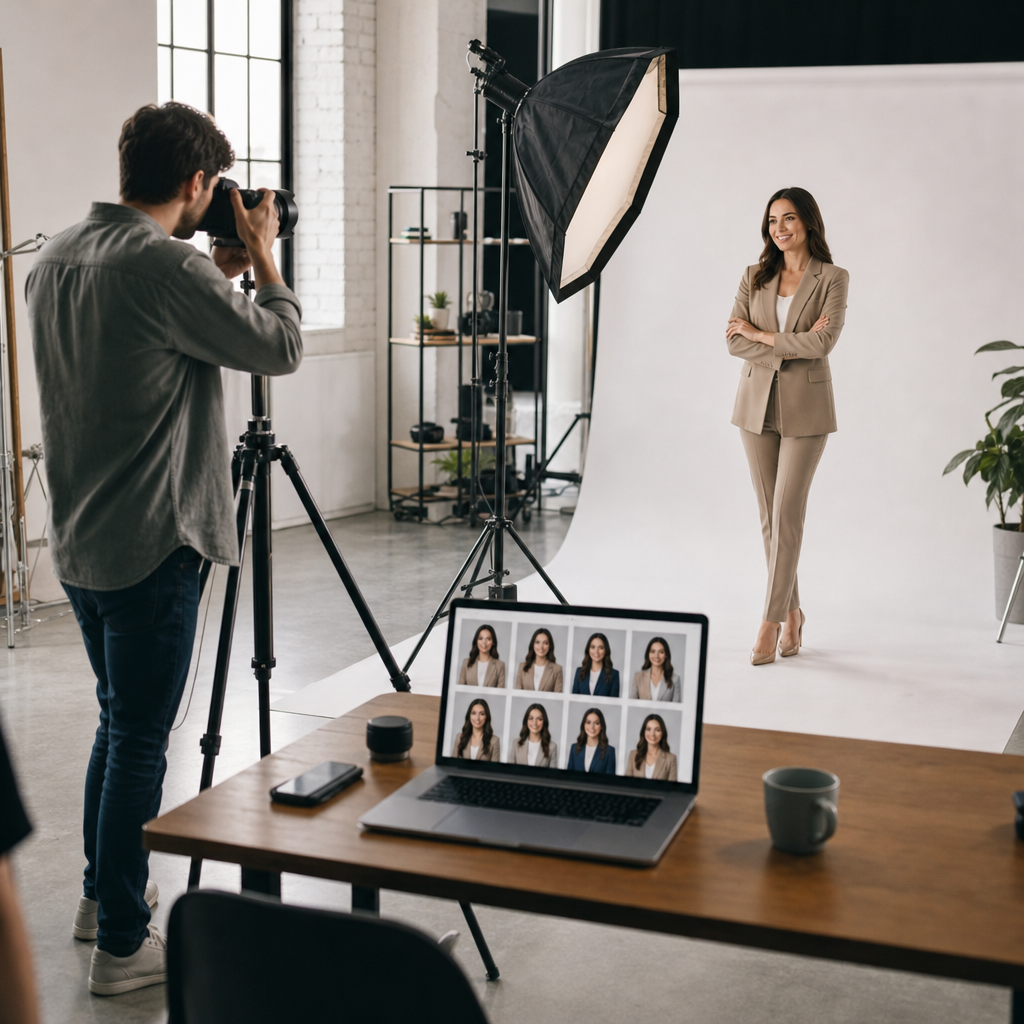
There is a particular kind of email that lands in a marketing coordinator's inbox every autumn, usually timed to the fiscal year's closing stretch: headshots needed for the new website by Friday. It arrives with the quiet dread of a dentist appointment. Someone has to book a photographer, someone has to find a studio or a conference room with decent light, and someone — usually the same someone — has to chase down the regional sales team, three of whom are traveling, one of whom is on leave, and one of whom has, for reasons nobody will explain, refused to be photographed since 2019. By the time the gallery comes back, the backgrounds don't match, the lighting varies by department, and the whole exercise has cost more in lost hours than in invoiced dollars.
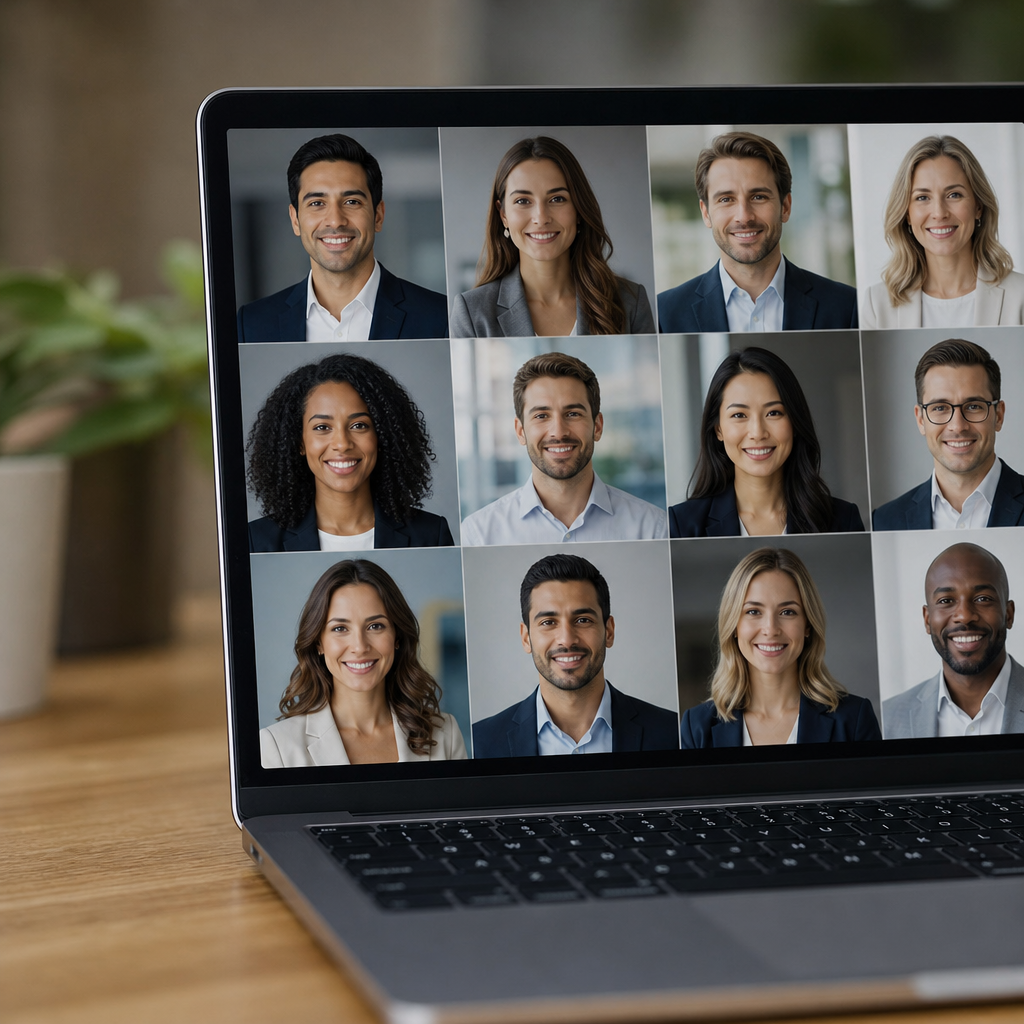
This was the scene, more or less, at a mid-sized logistics company outside Columbus in October, when the head of HR finally gave up on scheduling a traditional shoot for her scattered, hybrid workforce and tried something else entirely. Forty employees, working from kitchens and co-working spaces and one warehouse breakroom, uploaded selfies to an AI headshot generator for business and received, within the hour, a set of polished, studio-lit portraits that looked — improbably — like they'd all stood in front of the same backdrop on the same afternoon. Nobody had. That quiet trick, the illusion of a shared room that never existed, is the real story of what's happening to corporate photography in 2026.
The Studio That Isn't There
For most of the twentieth century, the headshot was a ritual with fixed costs: a photographer's day rate, a studio rental, a makeup artist if the budget allowed, and the unspoken tax of everyone's time. Vogue's own portraitists, from Irving Penn to Annie Leibovitz, built careers on the idea that a single, considered photograph could hold an entire persona — but that kind of control was never meant for the quarterly all-hands deck or the "Meet the Team" page of a regional accounting firm. Professional portraiture trickled down to the corporate world as an expensive approximation, and most companies simply made do: a photographer visited once a year, caught whoever happened to be in the office, and the gaps were filled with LinkedIn selfies taken in airport lounges and bathroom mirrors, backgrounds clashing, lighting ranging from fluorescent to tragic.
The AI headshot didn't begin as a correction to that problem so much as a personal convenience — a way for individuals to get a decent profile photo without paying three hundred dollars for forty-five minutes with a stranger holding a reflector. Harvard Business Review's reporting on hiring has long noted how disproportionately much weight a face attached to a résumé or profile carries in early-stage judgment, often before a single sentence is read. Recruiters, instructed or not, form impressions in seconds, and a photo that looks competent and current does quiet work that no cover letter can. Services like Headshot Lab emerged from that insight: upload a handful of selfies, choose an attire and background, and receive dozens of generated options — a kind of portrait session compressed into the time it takes to make a coffee.
What's changed since the earliest wave of these tools, when results could tip into uncanny valley — extra fingers, melted earlobes, a slightly too-symmetrical smile — is the sophistication of the underlying models and the discipline of the platforms built around them. The technology driving this shift borrows from the same diffusion-based image generation that MIT Technology Review has covered extensively in the context of generative AI's broader creative disruption — tools that learn the statistical texture of light on skin, the way a blazer collar folds, the particular softness of a studio key light, well enough to simulate it convincingly from nothing more than a phone camera and decent daylight. The result, when done well, isn't a cartoon of professionalism. It's something closer to a very good photographer's instinct, applied instantly and at scale.
What a Thousand Faces Have in Common
The logistics company in Ohio is not an unusual case; it is, increasingly, the norm. Businesses with distributed teams — a reality accelerated permanently by the pandemic years and chronicled at length by outlets like the Harvard Business Review and the Wall Street Journal in their ongoing coverage of hybrid work — have inherited a peculiar aesthetic problem. A remote-first company might have employees in Lisbon, Austin, and Manila, none of whom will ever occupy the same physical room, yet all of whom are expected to appear, side by side, on an "About Us" page with some visual coherence. The old solution was resignation: let everyone submit whatever photo they had. The new solution is quieter and more exacting — a shared backdrop, a shared lighting language, a shared sense of occasion, generated individually but experienced collectively.
This is where team packages have become the more interesting half of the AI headshot story, arguably more consequential than the individual use case that got the category started. A company can specify a background — a soft charcoal studio gray, a sunlit office interior, a brand-color gradient — and a dress code, then have every employee, regardless of where they're sitting when they take the photo, return a headshot that belongs unmistakably to the same set. Headshot Lab's team offering was built around exactly this problem: the idea that visual consistency across an organization shouldn't depend on everyone being in the same city on the same Tuesday.
There's something almost architectural about the effect. Walk into the lobby of a well-run company and the signage, the furniture, the even temperature of the lighting all communicate, before anyone says a word, that someone cared enough to make the details agree with each other. A staff directory page with forty matching headshots does the same work online. It's not vanity; it's coherence, the kind that signals competence by implication rather than assertion — a point Fast Company has made repeatedly in its coverage of brand consistency as an underrated driver of trust.
The Discomfort, and Why It's Shrinking
None of this has arrived without friction, and the friction is worth sitting with rather than smoothing over, because it's the most editorially honest part of the story. There remains a strain of skepticism — reasonable, often well-argued — about what it means to hand a defining image of yourself over to a model trained on patterns rather than a person trained in portraiture. Photographers have raised legitimate questions about authorship and authenticity, echoed in debates covered by outlets like The Guardian on AI's encroachment into creative professions. A headshot, after all, is meant to be evidence that a particular human exists and looks a particular way; if the lighting, the jacket, even the background are synthetic, is the photo still telling the truth?
The honest answer, at least as the technology stands in late 2026, is that it's telling a particular kind of truth — the same kind a well-lit studio session always told. No corporate headshot, AI-generated or otherwise, has ever been a documentary photograph. The traditional version involved just as much construction: a stylist's choice of jacket, a photographer's choice of angle, hours of retouching to smooth a complexion or correct a stray hair, all in service of presenting someone at their most composed, not their most candid. What's changed is who performs that construction and how quickly. The AI headshot simply makes explicit, and fast, a process that used to be slow, expensive, and hidden behind a photographer's Lightroom catalog.
Where real caution is warranted is in the handling of images that stray too far from the person submitting them — a jawline subtly reshaped, skin tone shifted toward something unrecognizable, an outcome that serves the algorithm's idea of "professional" rather than the actual human being's face. The better services in the category have made a point of guarding against exactly this, treating fidelity to the subject as a feature rather than an afterthought, and building in iteration — retouch credits, multiple style passes, the ability to reject a batch and try again — rather than delivering one algorithmic verdict and calling it finished. Headshot Lab's model of issuing dozens of options per upload, paired with a money-back guarantee, reflects that same instinct: the point isn't to let an algorithm decide how you look, but to give you enough raw material, generated fast and cheap, to recognize the version of yourself you'd actually want representing you in a boardroom or a byline.
The Etiquette of the New Face
There's a cultural dimension to all this that's easy to miss if you only think about it as a technology story. Every era has had its own etiquette for the professional face. The mid-century executive portrait, all dark suits and studio vignette, communicated institutional gravity. The 1990s corporate photo, often shot against a marbled gray backdrop with a slightly too-wide smile, communicated approachability within bounds. LinkedIn, when it launched in 2003 and especially once it matured into the default professional social graph documented by outlets like Forbes across the 2010s, created an entirely new genre: the profile photo as handshake, expected to convey competence, warmth, and currency all at once, cropped to a circle, viewed mostly at the size of a postage stamp on a phone screen.
The AI-generated headshot is simply the latest entrant in that lineage, suited to its moment the way the marbled backdrop suited its own. It exists because the modern professional's visual footprint has multiplied — a LinkedIn photo, a company bio photo, a conference speaker-badge photo, a press kit photo, a Slack avatar that somehow still matters more than it should — and because the traditional economics of producing all of those images separately never made sense for most people outside the executive suite. A freelance consultant or a job seeker updating a résumé photo for the fourth time in a job search doesn't have access to a photographer on retainer. What they have is a phone, decent daylight near a window, and twenty minutes.

That democratization is, in its way, the most editorially interesting thread running through this whole shift. For most of photographic history, a genuinely good portrait — properly lit, properly composed, flattering without being false — was a luxury good, available to executives with expense accounts and actors with publicists. The AI headshot generator doesn't just save time; it quietly dissolves a class boundary that used to separate people who could afford to look professionally photographed from people who couldn't. A barista finishing a degree and applying for her first analyst role can now arrive at the interview stage with a LinkedIn photo indistinguishable, at a glance, from the one belonging to the hiring manager who's been photographed by a staff photographer for a decade. Whether that's a small mercy or a minor leveling of a long-tilted field depends on how cynical you're feeling, but it's hard to argue it isn't, at minimum, useful.
The Room That Travels With You
Back in Columbus, the HR director who ran that forty-person experiment described the moment the gallery came back as faintly surreal: row after row of colleagues she knew from video calls and Slack threads, suddenly arranged as if they'd all filed through the same studio on the same bright afternoon, under the same gray backdrop, in the same register of navy and charcoal. Nobody had left their house. The warehouse employee's photo and the vice president's photo were, for the first time, visually indistinguishable in formality — not because the warehouse employee had been dressed up by a stylist, but because the software had simply extended to him the same polish it extended to everyone else, for the same low fee, in the same few minutes.
It's a small thing, in the scheme of what AI is reshaping across industries — nobody is claiming the corporate headshot generator belongs in the same conversation as the upheavals in medicine or logistics or climate modeling that outlets like Reuters track weekly. But small things accumulate into how institutions feel from the inside, and there is something genuinely new in a company being able to offer every employee, regardless of geography or rank, the same visual dignity at the same instant. The studio used to be a room you had to be invited into. Now, increasingly, it's a room that arrives wherever you already are — a laptop camera, a window with decent light, twenty quiet minutes — and leaves, when it's done, a version of your own face that finally looks like it was expecting to be seen. Headshot Lab, and the quiet industry it belongs to, didn't invent the desire to be photographed well. They just figured out how to stop making people wait for it.
Article written by FrontRank