 HEADSHOTLAB
The Selfie That Became a Portrait: On the Quiet Alchemy of the AI Headshot From Selfie

There is a particular kind of light that exists only in bathrooms at 7:42 in the morning — vanity bulbs overhead, a mirror slightly fogged at the edges, a phone held at an angle that no portrait photographer in history would ever recommend. It is in this light, more often than any studio could claim, that the modern professional photo now begins its life. Not as a sitting. Not as an appointment circled in red on a calendar. As a selfie, taken in forty seconds, deleted twice, kept on the third try because the eyes finally looked awake.
What happens to that photograph next is where the story gets interesting. A decade ago it would have stayed exactly what it was: a passable, slightly grainy image destined for a LinkedIn thumbnail that everyone privately agreed was "fine." Today it is raw material. Upload it, and within minutes it can emerge as something closer to what a Mayfair portrait studio or a Madison Avenue agency might have produced after a two-hour sitting, a lighting rig, and an invoice with three zeros on it. This is the premise — and increasingly the quiet norm — behind the AI headshot from selfie, a transformation so unglamorous in its inputs and so polished in its outputs that it has become one of the more understated technological reversals of the decade.
The Death of the Appointment
For most of the twentieth century, a professional portrait required submission to logistics. You booked a slot. You drove somewhere with parking you didn't trust. You sat under lights that made you blink, while a photographer — competent, often kind, occasionally theatrical — told you to drop your shoulder, relax your jaw, think of something pleasant. The entire apparatus of the corporate headshot industry was built around the idea that a convincing portrait could only be produced in the presence of specialized equipment and a specialized eye. Annie Leibovitz made a career, in part, out of proving how much craft actually lived in that process — how light could be sculpted, not just switched on.
That apparatus hasn't vanished. But it has been quietly outflanked by something much less ceremonious: a neural network trained on hundreds of thousands of professionally lit portraits, capable of inferring — from a single casual photograph — where the light should fall, how fabric drapes, what a believable studio backdrop looks like behind a human face. The selfie, once dismissed as the lowest form of self-documentation, turns out to contain everything an algorithm needs: bone structure, skin tone, the particular asymmetry of a real smile. The rest — the Patagonia vest or the charcoal blazer, the seamless grey backdrop, the gentle Rembrandt lighting — can be synthesized.
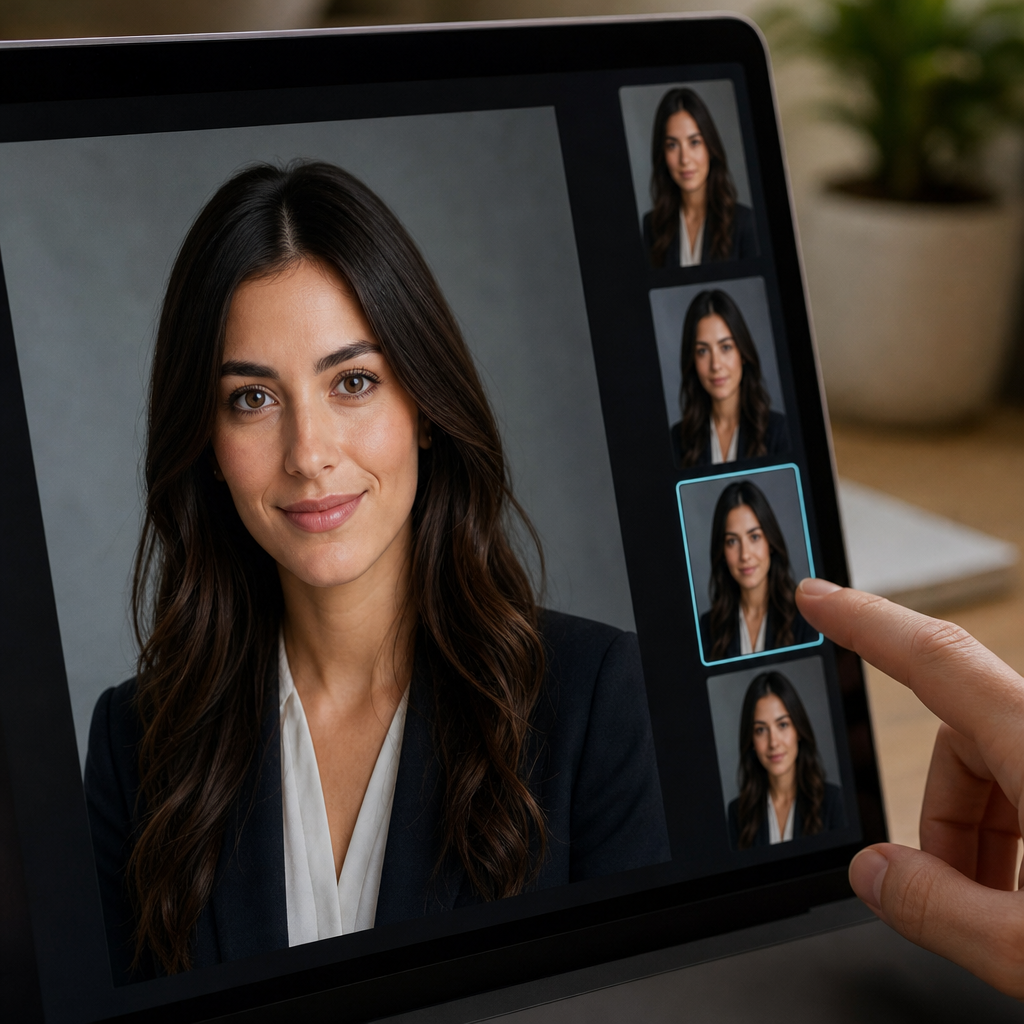
Headshot Lab occupies this specific moment in the story: the point where a dozen selfies taken on an iPhone in uneven light become twenty or thirty finished portraits, varied in attire and backdrop, ready for a LinkedIn banner or an "About Us" page by the time the coffee's gone cold. The company's premise is almost willfully unglamorous — there's no concierge, no studio address, no assistant adjusting a softbox — and that absence of ceremony is precisely the point. The ceremony was never what made the photograph convincing. The light was.
What the Mirror Never Told You
There's a reason people trust selfies less than they trust studio portraits, and it isn't really about image quality. It's about context. A studio portrait arrives pre-loaded with authority: someone paid for it, someone directed it, someone implicitly vouched for the subject by putting them in front of a camera with intention. A selfie, by contrast, carries the faint residue of its own casualness — it was taken alone, probably in a hurry, possibly for an entirely different purpose (a dating profile, a family group chat, proof of a new haircut).
What AI headshot generation does, structurally, is separate the likeness from the context. It keeps the bone structure, the real expression, the unmistakable specificity of an actual human face — the things a stock photo or an illustrated avatar could never replicate — and discards the bathroom mirror, the wrinkled T-shirt, the cereal box on the counter behind you. In its place, it reconstructs the context a studio would have provided: a backdrop in Pantone-approved neutral grey, a blazer that fits like it was tailored, light that falls just so across the cheekbone.
This is a strange kind of honesty, if you sit with it long enough. The final image is not a photograph of an event that happened — nobody stood in that studio, wore that blazer, was lit by that key light. And yet the face is entirely, verifiably real. It is less like retouching and more like translation: the same sentence, rendered in a more formal register. Researchers who study synthetic media and computer vision have spent years worrying, correctly, about the ways generative tools can manufacture faces that don't exist or distort faces that do. The headshot use case sits deliberately apart from that anxiety — the identity is fixed, verified, yours; only the styling is synthetic, in exactly the way a makeup artist or a wardrobe stylist has always been synthetic.
The Economics of Looking Competent
Ask anyone who has searched for a decent photographer ahead of a job change what the going rate looks like, and you'll hear numbers that have crept upward steadily, particularly in cities like New York, London, or Toronto, where a single hour with an experienced portrait photographer can run several hundred dollars before retouching fees are even discussed. For an individual job seeker — particularly one already navigating the uncertainty of a layoff, a pivot, a return to the workforce after parental leave — that cost is not trivial. It is, for many, the reason the headshot never got updated at all, and why so many LinkedIn profiles still feature a cropped wedding photo or a photo from a conference three jobs ago.
The Pew Research Center's ongoing work on the modern job search has repeatedly found that first impressions in digital hiring environments are compressed into seconds — recruiters report skimming a profile photo and a headline before deciding whether to read further. In a hiring landscape mediated almost entirely through screens, the photograph has become a disproportionately loud signal relative to how little most people consciously think about it. It is, in that sense, one of the few places where appearance and perceived competence are explicitly, if quietly, conflated — a bias that career coaches openly acknowledge and that outlets like the Harvard Business Review have examined in relation to hiring psychology and unconscious bias in recruitment.
Against that backdrop, the economics of an AI headshot from selfie are less about convenience and more about access. A single upload session, a modest one-time fee, and the ability to generate dozens of variations — different blazers, different backdrops, a version for the corporate directory and a slightly warmer one for a personal site — levels a field that used to tilt toward whoever could afford the photographer, the studio rental, the stylist. Headshot Lab's own structure, built around a one-time payment with retouch credits and a money-back guarantee rather than an hourly day-rate, is a direct response to that asymmetry. It doesn't pretend to replace what a bespoke editorial portrait session offers — the collaboration, the direction, the specific creative vision of a human photographer remains its own art form, one well documented by institutions like the International Center of Photography. It simply makes competent, polished self-presentation available to people for whom that was never previously a budget line.
The Office That Looks the Same From Every Angle
There's a second, less personal story happening alongside the individual one, and it involves teams rather than individuals. Any designer who has ever assembled a company "About Us" page knows the particular dread of the mismatched headshot grid: one colleague photographed against a brick wall in natural light, another against a hotel conference backdrop from a trade show two years ago, a third using what is unmistakably a passport photo. The effect, however talented the people in the images, is one of disorganization — a visual tell that the company either doesn't have the budget or doesn't have the discipline to standardize something as basic as how its people are presented.
Coordinating an in-person shoot for an entire distributed team has become, in the era of remote and hybrid work, a genuinely difficult logistical puzzle. Flying people to a single studio, or hiring a photographer to travel to five different cities, is expensive and slow, and by the time it's finished, someone has already changed roles or left the company. This is where team-oriented AI headshot tools find their more unexpected use case: not as a novelty for individuals updating a dating profile, but as an operational tool for HR and brand teams who need forty employees, across four time zones, to appear in front of the same backdrop, wearing a coordinated palette of attire, by Friday.
Headshot Lab's team packages address exactly this friction — matching backgrounds, consistent attire direction, a unified visual language across an entire staff directory, achieved without anyone boarding a flight or canceling a client call to sit under studio lights. It's a small logistical fix, but it solves a real and recurring design problem that most growing companies eventually run into: how do you look like one company, cohesively, when your people have never been in the same room?

A Brief History of Trying to Look Like Yourself, But Better
It's worth remembering that none of this — the anxiety, the editing, the desire for a version of your face that is unmistakably you but somehow more composed — is new. Renaissance portraiture routinely flattered its subjects, smoothing a Medici jawline here, adding a few inches of height there. Studio photographers of the mid-twentieth century relied heavily on physical retouching — scraping negatives, airbrushing prints — long before Photoshop gave the practice a software interface. Vanity Fair's own portrait archives, chronicled in exhibitions and retrospectives covered by outlets like The New York Times, are full of images that were meticulously constructed rather than simply captured.
What's different now is not the impulse but the access point. The tools that once required a darkroom, then a copy of Photoshop and a few years of training, now require only a phone and a few minutes of patience. The AI headshot from selfie is, in this longer view, simply the latest and most democratized chapter in a very old human project: the desire to be seen the way we feel on our best days, rather than the way a fluorescent-lit DMV camera happens to catch us.
There is something almost touching in how literally people take this. Career coaches report that clients will spend longer selecting which of thirty AI-generated headshot variants to use than they ever spent on the original studio sitting, agonizing over whether the navy blazer reads as "approachable" or "severe," whether the slightly warmer backdrop suggests creative industries while the cooler grey suggests finance or law. This is not vanity so much as fluency — a recognition that in professional contexts increasingly mediated by a single thumbnail, image is doing real communicative work, the way a firm handshake or a tailored suit once did in rooms we no longer occupy as often.
The Face Before the Meeting
What remains constant, through all of this, is the strange intimacy of the selfie itself — the fact that the raw material for all of it is still a photograph nobody else took, taken by the person who knows their own face better than any photographer ever could, however briefly, in whatever light was available that morning. The algorithm doesn't invent confidence; it can only find what's already there and let it surface without the usual noise — the unmade bed, the bad lighting, the self-consciousness of being looked at by a stranger with a camera.
Perhaps that's the real shift worth noticing: not that artificial intelligence can manufacture a convincing portrait, which was, in truth, always just a matter of time and sufficient training data, but that the starting point has moved from the studio to the self. The photograph that used to require an appointment now requires only a moment of attention in front of a mirror, and what comes back, minutes later, is recognisably, stubbornly, still you — just introduced properly, for once, to the room you're about to walk into. Platforms like Headshot Lab have simply made that introduction a little easier to arrange, for the individual trying to look like themselves on their best day, and for the whole office trying, at last, to look like one office.
There's a version of this story that ends with a warning about authenticity, about how a generated backdrop can never replace the particular grain of a real room, a real photographer's real eye. That version isn't wrong, exactly, but it misses the quieter truth sitting underneath all of it: the photograph was never really about the room. It was about the forty seconds before the picture was taken, when someone looked at themselves and decided, however briefly, that they were ready to be seen.
Article written by FrontRank